Work titles are retained in Chinese; references link to the original sources.
Zhao Mengfu(趙孟頫)
Late Song and early Yuan · 1254–1322
Courtesy name Zi’ang; sobriquet Songxue Daoren. A native of Huzhou and a member of the Song imperial family who served the Yuan, he excelled in poetry, prose, calligraphy, painting and connoisseurship, and advocated studying Jin and Tang models.
Biography
Zhao Mengfu, courtesy name Zi’ang, was a native of Huzhou descended from Zhao Kuangyin, Emperor Taizu of Song. He received an official appointment at fourteen through hereditary privilege from his father and studied at home after the fall of Song. In 1286, the twenty-third year of Zhiyuan, Emperor Shizu of Yuan sent Cheng Jufu to recruit scholars in the south, and Zhao entered court service. A member of the Song imperial family serving the dynasty that conquered Song became a central tension in assessments during his life and afterwards. Calling him simply a Yuan calligrapher would omit this background.[1][2]
《元史》 records many administrative details from his early Yuan service. He opposed mechanically calculating the monetary threshold for capital punishment for corruption using the face value of depreciated paper currency, arguing that the law concerned human lives. When sent to investigate officials in the south, he flogged no one despite having authority to do so. He later spoke to a court insider about harsh levies and helped secure reductions. His standing at court depended on literary and political abilities as well as his art.[1]
In 1292, the twenty-ninth year of Zhiyuan, Zhao requested a provincial appointment to avoid suspicion at court and became deputy administrator of Jinan Circuit. 《元史》 recounts his doubt about a reported murder of a man who had fled compulsory saltworks service. He delayed judgment; the man later returned and the wrongful accusation was cleared. Zhao also held offices including supervisor of Confucian education in Jiangsu and Zhejiang. Provincial service connected him with scholars from north and south, monasteries and patrons commissioning inscriptions.[1][2]
Under Emperor Renzong he again received distinction, serving as a Hanlin lecturer and later as a senior Hanlin academician. The emperor compared his literary gifts with those of Li Bai and Su Shi, praising his learning, painting and calligraphy. 《元史》 also records objections to a member of the Song imperial family taking part in the compilation of national history; the emperor nevertheless defended his scholarly position. His long residence in the south and periods of duty in Dadu meant that his works served friends, scholars, monasteries and the imperial household.[1]
His wife Guan Daosheng was also accomplished in calligraphy and painting, and their sons Zhao Yong and Zhao Yi continued the family tradition. 《元史》 and the Palace Museum’s research describe this familial and artistic network. Friends and fellow artists such as Zhou Mi and Xianyu Shu provided occasions for exchanging and discussing works. In 1295 Zhao painted 《鵲華秋色》 for Zhou Mi, allowing him to imagine the landscape of his ancestral home in Jinan, which he had never visited; a scroll of 《趵突泉詩》 relates to the same period. Painting and calligraphy often arose within the same social exchanges rather than as unrelated arts.[1][6][7][8]
Zhao advocated studying Jin and Tang calligraphy and painting. He practised after Zhong Yao, the Two Wangs, Zhiyong and Tang masters, stressing the spirit of antiquity and brush technique. Several authentic versions of 《千字文》 listed by the Palace Museum differ in script, date and present location; some other transmitted versions with similar titles remain disputed. “Zhao style” conveniently names his influence but can conceal the continuing changes from youth to old age and from small regular to cursive script.[5][9]
《帝師膽巴碑》 of 1316, the third year of Yanyou, is a long regular-script scroll composed and written on imperial order late in his life. It connects a Tibetan Buddhist imperial preceptor, Yuan court ritual and the inscription for Longxing Temple. The Palace Museum sees its brushwork as combining Li Yong, Liu Gongquan and the Two Wangs: orderly without stiffness. Zhao died in 1322 and was posthumously made Duke of Wei with the name Wenmin. Ethical judgments of his Yuan service differ, but assessments of technique and authenticity in individual works must still rest on evidence from those works.[1][4]
Works and writings
- 《帝師膽巴碑》: composed and written for Longxing Temple on imperial order in 1316, preserved as a paper scroll in regular script at the Palace Museum, Beijing. It is evidence both of Zhao’s late regular script and of Yuan religious and inscription history.[4]
- 《書趵突泉詩》: connected with the social context of 《鵲華秋色》 of 1295. From its content and Zhou Mi’s death date, the National Palace Museum, Taipei, dates the surviving scroll to between 1295 and 1304. The date of the poem cannot simply be taken as the exact date of the calligraphic scroll.[7]
- Versions of 《千字文》: a Palace Museum symposium summary reports research identifying six surviving authentic works in the Palace Museum, Beijing, Shanghai Museum and private collections, and discussing the disputed authenticity of two others. Similar titles in regular-and-cursive, running or regular script refer to distinct scrolls.[9]
- 《洛神賦》 scrolls: calligraphy based on a classical literary text. The Palace Museum includes this among Zhao’s representative running-script works; dating and transmission must still be examined for each particular scroll.[10]
Relationships
- Cheng Jufu: recruited talent in the south on Emperor Shizu’s orders and recommended Zhao for service at the Yuan court.[1]
- Guan Daosheng: his wife, also renowned for calligraphy and painting. Their sons Zhao Yong and Zhao Yi continued the family’s artistic learning.[1][8]
- Zhou Mi: a scholar and friend from the late Song. Zhao’s 《鵲華秋色》 and 《趵突泉詩》 responded to Zhou’s memories of his ancestral home in Jinan.[6][7]
- Xianyu Shu: a fellow Yuan calligrapher and critic. Their calligraphy offered points of comparison for one another; they should not be described simply as teacher and pupil.[3]
- Emperors Shizu and Renzong of Yuan: successively summoned and employed Zhao. Renzong treated him with particular distinction and commissioned inscriptions from him.[1][4]
- Wang Xizhi, Wang Xianzhi and Zhiyong: models studied across historical periods, not teachers who instructed him in person.[5]
Assessment
- 《元史》 praises Zhao’s command of a wide range of scripts, including seal, ancient seal, clerical, regular, running and cursive forms. Its sweeping claim of superiority to all past and present masters belongs to the praise of traditional biography and should be considered alongside individual works.[1]
- Emperor Renzong praised Zhao’s extensive learning and exceptional painting and calligraphy, comparing his literary gifts with those of Li Bai and Su Shi. This was the highest contemporary praise, but it also reflects relations between ruler and official and the setting of court taste.[1]
- Xianyu Shu wrote a specific colophon on Zhao’s small regular-script 《過秦論》, included in the Palace Museum’s compilation of comments. Contemporary assessments can be read separately from rankings established by later generations.[3]
- In its analysis of 《帝師膽巴碑》, the Palace Museum identifies the vigour of Li Yong and Liu Gongquan together with the grace of the Two Wangs, transforming steep, forceful forms into dignified composure. This assessment of a particular late work is more precise than a general description of Zhao’s style as polished and rounded.[4]
- The Palace Museum’s study of his artistic sources emphasises his use of ancient models to address the calligraphic tendencies of his own time. Drawing on Zhong Yao, the Two Wangs, Zhiyong and Tang masters, he developed his own strokes and structures. His revival of antiquity was a means of creating anew, rather than mechanical imitation.[5]
- From the Ming and Qing onward, some critics condemned Zhao’s character for serving the Yuan as a Song imperial descendant and projected that judgment onto descriptions of his calligraphy as soft or ingratiating. Palace Museum and modern scholarship advise examining political ethics, artistic form and authentication as separate questions.[1][3][5]
Related works(2)
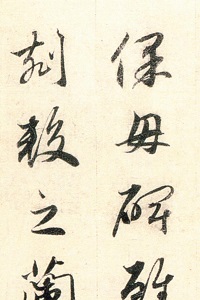 保母磚跋卷
保母磚跋卷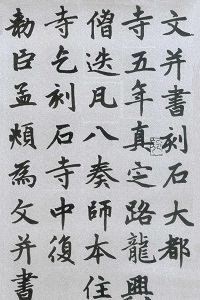 膽巴碑
膽巴碑Timeline
- Born into a branch of the Song imperial family in Huzhou.[1][2]
- Continued his studies at home after the fall of Song.[1]
- Entered the Yuan court on Cheng Jufu’s recommendation and held offices including director in the Ministry of War.[1][2]
- Became deputy administrator of Jinan Circuit and dealt with local administration.[1][2]
- Painted 《鵲華秋色》 for Zhou Mi; 《趵突泉詩》 relates to the same social exchange.[6][7]
- Served as a Hanlin lecturer and senior Hanlin academician, among other appointments.[1][2]
- Composed and wrote 《帝師膽巴碑》 on imperial order.[4]
- Died and received the posthumous name Wenmin.[1][2]
References
- 《元史》, vol. 172: biography of Zhao Mengfu
- The Palace Museum, Beijing: chronology of Zhao Mengfu
- The Palace Museum, Beijing: historical assessments of Zhao Mengfu
- The Palace Museum, Beijing: 《帝師膽巴碑》
- The Palace Museum, Beijing: Zhao Mengfu’s artistic sources
- National Palace Museum, Taipei: 《鵲華秋色》
- National Palace Museum, Taipei: 《書趵突泉詩》
- The Palace Museum, Beijing: Zhao Mengfu’s artistic influence
- The Palace Museum, Beijing: symposium marking the 700th anniversary of Zhao Mengfu’s death, including a report on 《千字文》
- The Palace Museum, Beijing: 《趙孟頫洛神賦》