Work titles are retained in Chinese; references link to the original sources.
Wu Changshuo(吳昌碩)
Late Qing and early Republic · 1844–1927
Originally Jun, courtesy name Junqing, later using Changshuo as his name; a native of Anji, Zhejiang. Antiquities, seals and 《石鼓文》 informed his writing and a synthesis of poetry, calligraphy, painting and carving.
Biography
Wu was born in Anji. A Palace Museum entry gives original name Jun and courtesy name Junqing, later Changshuo, with sobriquets Foulu and Kutie; an exhibition account treats Jun and Junqing as earlier names. His father and grandfather held provincial examination degrees and maintained a learned household. Taiping warfare displaced Wu and his father for years; on return he learned that his mother and fiancée had died and the home was ruined. These experiences accompany his later Bitter Iron sobriquet.[1][2]
After returning he farmed, studied, gained the first examination degree and worked as tutor and administrative aide while meeting Yang Xian, Pu Hua, Ren Yi and others. Writing and seals preceded concentrated painting. The museum exhibition places intensive painting study after forty, while another entry says he began experimenting in his thirties at friends’ encouragement. These accounts can describe different stages of initial practice and sustained commitment.[1][2]
Around fifty-five he briefly served as Andong magistrate, resigning quickly and carving a seal claiming to have left office fifty days earlier than the magistrate of Pengze. Later he lived mainly in Suzhou and Shanghai, creating and exchanging art. Elected the first Xiling Seal Society president in 1913, he helped shape modern seal-study organisation. The office must not be backdated to its 1904 founding. He died in Shanghai in 1927.[1][3][7]
Lifetime study of 《石鼓文》 anchors his seal script. The Palace Museum stresses repeated copying and gradual transformation of structure, brushwork and column movement. Shanghai’s 《石鼓文八言聯》 turns ancient carved characters into powerful, substantial modern paper couplets. Original stone drums, historical rubbings, Wu’s copies and new compositions in that manner are four different materials.[2][4][5]
His seals draw on ancient and Qin–Han seals, brick and tile characters, and stone-drum movement. Paintings integrate seal–clerical lines in plants with poems and impressions. The Palace Museum examines the reciprocal entry of writing, carving and painting. His flower-and-bird art influenced Shanghai and modern expressive painting, while each medium retained distinct materials and purposes.[1][6]
His career crosses Qing and Republic and his names changed with age. Dating only from the signature Changshuo or assigning every 《石鼓文》 scroll the same year is unreliable. Presidency expanded his influence abroad, while museum objects reveal continued change even in late writing.[1][3][4][5]
Works and writings
- 《石鼓文八言聯》: Shanghai Museum; ancient stone-drum structures translated into paper couplets, assessed as substantial and vigorous.[4]
- Multiple 《臨石鼓文》 scrolls: museum exhibitions and research show repeated study throughout his life. Text, date and stylistic changes must be catalogued work by work.[2][5]
- The seal declaring retirement fifty days earlier than the magistrate of Pengze: carved after brief Andong service, connecting autobiography with Tao Yuanming’s resignation.[1]
- Flower paintings and inscriptions: seal–clerical lines form branches, while poems and self-carved seals complete the image. Paintings are not simply independent calligraphic works.[1][6]
- 《缶廬詩存》: a poetry collection providing texts for artistic inscriptions, rather than a single-year autograph scroll.[1]
Relationships
- Wu Xinjia: his father, displaced with Wu during warfare before returning to Anji.[1]
- Pan Zhiqi: identified by the Palace Museum as an early painting teacher.[1]
- Yang Xian, Pu Hua and Ren Yi: artistic friends and advisers who broadened inscription and painting knowledge; not all should be treated as formal teachers.[1]
- Xiling Seal Society members: elected him first president in 1913, creating a platform for exchange and transmission.[3][7]
- Chen Chun, Xu Wei, Zhu Da and Shitao: earlier painting models, rather than living acquaintances.[1]
Assessment
- The Palace Museum values lifelong exploration of 《石鼓文》 and renewal through antiquity, stressing transformation from copying to a personal manner.[2][5]
- Shanghai describes 《石鼓文八言聯》 as substantial and vigorous in strokes and structure, departing from convention in a specific paper work.[4]
- The Palace Museum explains interactions among lines, density, inscriptions and seal impressions, showing how epigraphic movement helped create a new Shanghai painting manner.[1][6]
- Xiling records his 1913 presidency and celebrates excellence in poetry, writing, painting and seals. This institutional perspective reflects modern seal artists’ esteem.[3][7]
- The Palace Museum calls him a leader of the later Shanghai school, concerning late painting influence. This belongs alongside preceding decades of inscription and seal study.[1]
Related works(1)
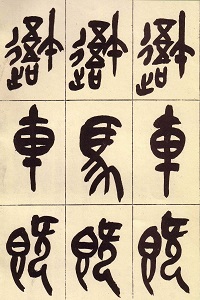 吳昌碩臨石鼓文
Timeline
- Born in Anji, Zhejiang.[1][2]
- Displaced by war with his father, later returning to farm, study, write and carve.[1]
- Travelled and met Yang Xian, Pu Hua and Ren Yi while continuing study of 《石鼓文》.[1][5]
- Briefly served as Andong magistrate, resigned and carved an autobiographical resignation seal.[1]
- Elected first president of the Xiling Seal Society.[3][7]
- Died in Shanghai.[1][2]
References
- The Palace Museum: Wu Changshuo
- The Palace Museum: calligraphy, painting and seal exhibition
- Xiling Seal Society: first president Wu Changshuo
- Shanghai Museum: 《石鼓文八言聯》
- The Palace Museum: 《石鼓文》 and seal-script studies
- The Palace Museum: writing and carving in Wu’s painting
- Xiling Seal Society: institutional history and the 1913 election