Work titles are retained in Chinese; references link to the original sources.
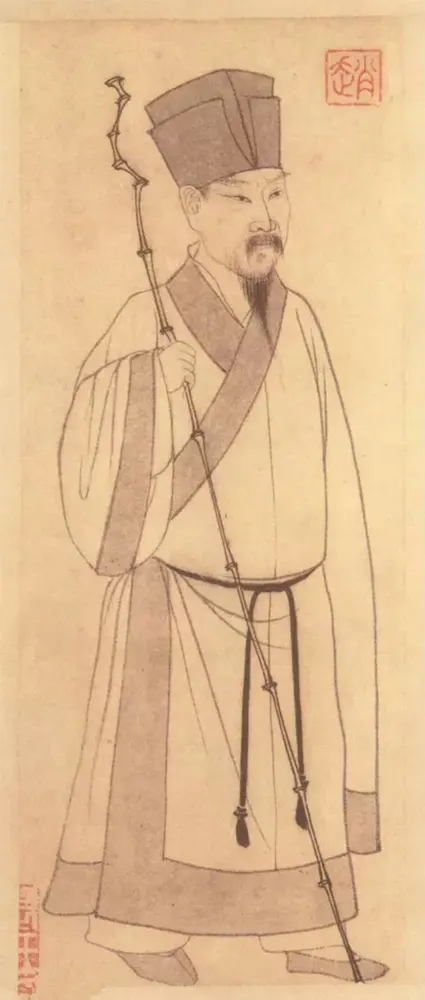
Su Shi(蘇軾/蘇東坡)
Northern Song · 1037–1101; some museum records give 1036 as the birth year
Courtesy name Zizhan; sobriquet Dongpo Jushi. A native of Meishan, he combined poetry, prose, calligraphy, painting and political service. The works associated with his Huangzhou exile are particularly important.
Biography
Su Shi, courtesy name Zizhan, came from Meishan. While his father Su Xun travelled to study, his mother Lady Cheng taught him classics and history. 《宋史》 recounts their discussion of the Han official Fan Pang to illustrate early connections between public service and integrity. His brother Su Zhe also became a writer and politician; father and sons became the Three Sus. Early reading of history, classics and 《莊子》 informs his concern for learning, breadth of spirit and natural expression in writing.[1]
In the 1057 Ministry of Rites examination, Ouyang Xiu admired 《刑賞忠厚之至論》 but withheld first place, mistakenly believing it to be by his pupil Zeng Gong. 《宋史》 also records Su’s later third-class placement in the special examination. He served in Fengxiang, Hangzhou, Mizhou and Xuzhou, handling service obligations, floods and local government. He was not simply a recluse removed from public affairs.[1]
Under Shenzong, Su questioned aspects of Wang Anshi’s reforms, including examinations and labour obligations, and served outside the capital. Their political differences also involved judgments on particular administrative matters; his career cannot be reduced to the label of opposition to reform. In 1079 accusations concerning his poetry and prose led to imprisonment. After release he was assigned a restricted post in Huangzhou.[1]
In Huangzhou he cultivated Dongpo, visited Red Cliff and composed 《黃州寒食詩》, 《前赤壁賦》 and 《後赤壁賦》. The poem 《寒食詩》 dates to 1082, but the surviving 《書黃州寒食詩》 scroll was written afterwards, as the Taipei museum emphasises. The prose 《前赤壁賦》 also dates to 1082, whereas its surviving scroll was written in 1083 at Fu Yaoyu’s request. Life events, literary composition and production of a particular ink work must not be assigned one common date.[2][3]
After Zhezong’s accession, Su returned as a Secretariat drafter and Hanlin scholar, then governed Hangzhou, Yingzhou, Yangzhou and elsewhere. 《宋史》 describes Hangzhou water management and public welfare, showing continued activity chiefly as an official even as his artistic reputation grew. Repeated factional changes also altered his political position, appointments and policy judgments.[1]
In the Shaosheng reign he was exiled again, first to Huizhou and then Danzhou. In Hainan he continued writing and teaching, maintaining contact with relatives and local scholars; his son Su Guo accompanied him for years. Pardoned at the end of Yuanfu, he travelled north and died in Changzhou in 1101. Huizhou and Danzhou experiences belong alongside Huangzhou in accounts of his late writing.[1][7]
Su used regular, running and cursive scripts and stressed learning and mental condition in his theory. He studied Wang Sengqian, Li Yong, Yan Zhenqing, Yang Ningshi and others without aiming to duplicate one manner. The purposes, texts and transmission of his works differ: 《寒食詩》 records his own poetry, 《前赤壁賦》 responds to a friend’s request, and the paired 《洞庭春色賦》 and 《中山松醪賦》 are late transcriptions of his own prose.[2][3][4][6]
Works and writings
- 《書黃州寒食詩》: the poetry dates to 1082 and the writing to a later occasion. Taipei’s paper scroll measures 34.2 × 199.5 cm. Deletions, corrections, changing character sizes, long verticals and spacing respond to the poem; Huang Tingjian’s colophon survives at the end.[2]
- 《前赤壁賦》: composed in 1082; the Taipei museum dates the surviving Su scroll to 1083, written for Fu Yaoyu. Its restraint contrasts with 《寒食詩》, showing why one work cannot define his whole manner.[3]
- Paired 《洞庭春色賦》 and 《中山松醪賦》: two wine-themed prose pieces. Palace Museum research places their combined transcription in the intercalary fourth month of 1094, when rain delayed Su on his journey to Yingzhou. Composition of the texts and production of the scroll require separate dates.[4]
- 《答謝民師論文帖》, 《祭黃幾道文》 and correspondence: listed by the Palace Museum among transmitted Su works. Literary criticism, memorial prose and letters have different purposes; ink originals, old copies and engraved model books must be distinguished.[6]
- 《石蒼舒醉墨堂》: a poem, rather than the title of an ink work. Its statement that his writing arises from intent rather than fixed rules does not imply a refusal to study earlier methods.[5]
Relationships
- Su Xun and Su Zhe: his father and brother, together known as the Three Sus. Su Zhe later wrote his epitaph.[1][7]
- Lady Cheng: his mother and childhood teacher of classics and history; 《宋史》 preserves accounts of her teaching.[1]
- Ouyang Xiu: admired Su’s examination essay and later recommended him, assisting his official career.[1]
- Wang Anshi: a contemporary with whom he often differed on reform policy and political arguments.[1]
- Su Guo: his son, who accompanied him and cared for him during the later Huizhou and Danzhou exiles.[1]
- Fu Yaoyu: a friend whose request, according to the Taipei museum, occasioned the surviving 《前赤壁賦》 scroll.[3]
- Huang Tingjian: exchanged poems and artistic judgments with Su and added a colophon to 《寒食詩》. They were later paired as Su and Huang.[2]
- Wen Tong: a relative and fellow bamboo painter, important to Su’s painting theory and literati artistic circle.[6]
Assessment
- In 《石蒼舒醉墨堂》, Su poetically presents a relationship between creative intention and form. His broad study of earlier masters prevents interpretation of this claim as disregard for brush technique.[5][6]
- Huang Tingjian’s colophon on 《寒食詩》 compares the poem with Li Bai’s finest and suggests that even Su could not necessarily surpass this scroll by writing it again. Taipei dates the colophon before the ninth lunar month of 1100. This contemporary judgment concerns a particular work’s poetry and calligraphy together.[2]
- Taipei analyses stretching and contraction of characters, long verticals and changing density in 《寒食詩》 as responses to the poem’s sorrow and indignation. Expression is explained through visible composition rather than a general appeal to emotion.[2]
- Taipei describes 《前赤壁賦》 as disciplined, with rounded, substantial brushwork. Its discussion of bone, flesh, blood, energy and spirit relates to structures, lines and brush movement. Compared with 《寒食詩》, it demonstrates restraint and freedom under different circumstances.[3]
- The concluding assessment in 《宋史》 praises Su’s writing, arguments, government and integrity, noting Ouyang’s early recognition. Historical judgment embraces politics and literature, beyond membership in the Four Song Masters.[1]
- The pairing of Su, Huang, Mi and Cai is a later convention. Su’s running script is often called full-bodied, but the transformations in 《寒食詩》 and discipline of 《前赤壁賦》 show the limits of a single adjective.[2][3][6]
Related works(1)
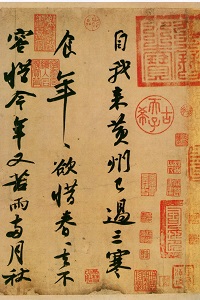 寒食帖
寒食帖Timeline
- Born in Meishan. Taipei’s description of 《寒食詩》 gives 1036, reflecting a difference in birth-year calculation.[1][2][3]
- Ouyang Xiu recognised his essay in the Ministry of Rites examination; he subsequently entered official service.[1]
- Debated reform policy under Wang Anshi and held successive provincial appointments.[1]
- Imprisoned in the poetry case, then assigned to Huangzhou after release.[1]
- Composed 《寒食詩》 and the earlier and later 《赤壁賦》 at Huangzhou. The surviving 《寒食詩》 scroll was written afterwards.[2][3]
- Wrote the 《前赤壁賦》 scroll at Fu Yaoyu’s request.[3]
- Wrote the paired 《洞庭春色賦》 and 《中山松醪賦》 while travelling toward exile in Huizhou.[4]
- Transferred to Danzhou and continued writing and teaching in Hainan.[1][7]
- Died in Changzhou after being pardoned and returning north.[1][7]