Work titles are retained in Chinese; references link to the original sources.
Ouyang Xun(歐陽詢)
Chen, Sui and Tang · 557–641
Courtesy name Xinben; a native of Linxiang, Tanzhou. A scholar of classics and history and a court official across three dynasties, he was also the early Tang calligrapher whose mature writing became known as the Ouyang style.
Biography
Ouyang Xun was born under the Chen dynasty in Linxiang, Tanzhou. 《舊唐書》 records that his grandfather Ouyang Wei and father Ouyang He served Chen. When his father, governor of Guangzhou, was executed for rebellion, the young Ouyang narrowly escaped collective punishment. Jiang Zong, director of the Department of State Affairs and an old family friend, adopted him and taught him reading and writing. This history explains how his education continued after family catastrophe more precisely than a generic account of an elite childhood.[1]
《舊唐書》 describes him as perceptive and widely read, especially in 《史記》, 《漢書》 and 《後漢書》. Under Sui he became an erudite in the Court of Imperial Sacrifices. His literary training connects with his later direction of a major encyclopaedia: calligraphy was part of scholarly and administrative life. No year-by-year record of his Chen education survives, so dates for youthful works must not be invented.[1]
Li Yuan invited Ouyang to his circle before founding Tang. He later became a supervising secretary. In 624 he joined Pei Ju, Chen Shuda and others in compiling the hundred-volume 《藝文類聚》 on imperial order. Arranging passages from earlier books by subject, this reference work served court writing and scholarly research, revealing Ouyang’s role as a bibliographical scholar and official.[1]
Early in the Zhenguan reign he became director of the Crown Prince’s Court and a Hongwen Academy scholar, and was ennobled as Baron of Bohai. His later designation Ouyang Shuaigeng derives from that office. 《舊唐書》 says he first studied Wang Xizhi and gradually transformed his manner into forceful, precariously balanced writing. Even his letters were treated as models, and Goguryeo envoys sought his work. Gaozu remarked on his fame abroad. His influence was already established during his lifetime.[1]
His regular script exceeds an abstract ideal of squareness. Wei Zheng composed 《九成宮醴泉銘》, which Ouyang wrote in 632 to commemorate a spring discovered by Taizong at Jiucheng Palace. Political praise and a large public commission shaped its characters, columns, carving and court setting. The Palace Museum’s Song rubbing preserves earlier carved detail; repeated rubbing, wear and recutting account for differences in later impressions.[3][6]
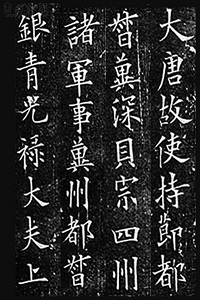
《化度寺邕禪師塔銘》, 《皇甫誕碑》 and 《虞恭公碑》, together with 《九成宮醴泉銘》, display his monumental writing. Variations in stone preservation and rubbing dates affect surviving stroke detail. Compact, tilted structures nevertheless show careful control of overall balance.[2][3][6]
Ouyang died in 641. 《舊唐書》 describes his son Ouyang Tong, who lost his father young and was urged by his mother, Lady Xu, to study his father’s writing. Their designation as the elder and younger Ouyang rests on a real familial and educational connection, but works by two generations should not be merged into a single attribution.[1]
Works and writings
- 《九成宮醴泉銘》: composed by Wei Zheng and written by Ouyang in 632, chiefly transmitted through stone rubbings. The date and preservation of the Palace Museum’s Song rubbing make it important for studying his late writing and changes in the monument.[3][6]
- 《化度寺邕禪師塔銘》: a Buddhist memorial of the Zhenguan reign, useful for studying compact but varied regular script. The stone and the collecting histories of individual rubbings must be distinguished.[2]
- 《皇甫誕碑》: Ouyang’s calligraphy commemorates the Sui official Huangfu Dan. The relative dates of writing and carving should not be inferred solely from tradition.[2]
- 《虞恭公碑》: a late commemorative monument which, with 《九成宮》, offers evidence for his mature regular script. Its present appearance is mediated by carving and rubbing.[2]
- 《藝文類聚》: the hundred-volume encyclopaedia he helped compile by imperial order in 624. It is a scholarly publication, rather than a personal calligraphic autograph.[1]
Relationships
- Ouyang He: his father, governor of Guangzhou under Chen, executed for rebellion. Ouyang Xun escaped punishment as a child.[1]
- Jiang Zong: an old friend of his father who adopted and educated him. 《舊唐書》 documents this early educational relationship.[1]
- Li Yuan and Li Shimin: successive rulers whom he served. Li Yuan invited him into his circle before Tang; under Taizong he held posts in the Crown Prince’s Court and Hongwen Academy.[1]
- Pei Ju and Chen Shuda: colleagues in the imperially commissioned compilation of 《藝文類聚》.[1]
- Wei Zheng: composed 《九成宮醴泉銘》, for which Ouyang supplied the calligraphy. They shared literary and calligraphic responsibilities on the same monument.[3]
- Ouyang Tong: his son, educated in his father’s writing at his mother’s urging after early bereavement. They were known as the elder and younger Ouyang.[1]
- Wang Xizhi: an early model. 《舊唐書》 says Ouyang studied Wang and then transformed the style; they were not contemporary teacher and pupil.[1]
Assessment
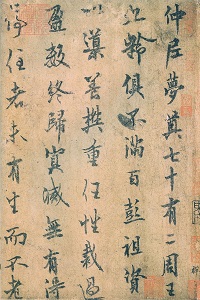
- 《舊唐書》 describes study of Wang Xizhi followed by transformation into an independent, forceful style, and says contemporaries treated his letters as models. This relatively early historical assessment also establishes the esteem of his running-script correspondence.[1]
- The Palace Museum describes the Song rubbing of 《九成宮醴泉銘》 as a late work with substantial, deeply vigorous strokes and full structures. Reducing the Ouyang style to thin hardness misses this mature work’s richness.[3]
- Guo Shangxian’s Qing assessment of 《九成宮醴泉銘》, cited by the Palace Museum, values its interweaving of Han clerical and Wei–Jin regular methods, with angular and rounded handling together. This is a later reading of a specific monument, not Ouyang’s own account.[3]
- The attributed 《書論》 presents brushwork and structure through mutually balancing slant and straightness, openness and density, thickness and thinness, rejecting a light head with a heavy tail or unbalanced leaning. Texts under his name have complex transmission histories. They illuminate later teaching of his style without proving every sentence an authenticated authorial draft.[4]
- Ruan Yuan’s Qing 《南北書派論》 places Ouyang and Chu Suiliang in the northern line, stressing ties to Northern and Southern Dynasties monuments. This is nineteenth-century classification, rather than evidence that either Tang artist claimed such a school.[5]
- Repeated rubbing, wear and recutting alter impressions of 《九成宮》. The Palace Museum contrasts early and late rubbings to remind viewers that judgments of Ouyang’s brushwork often concern stone impressions made centuries apart.[6]
Related works(12)
 丘師墓志
丘師墓志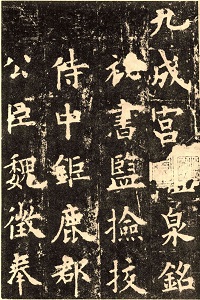 九成宮碑
九成宮碑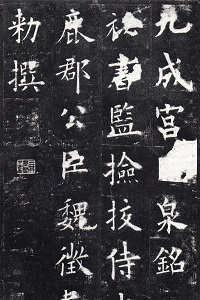 九成宮碑-二玄社
 仲尼夢奠帖
仲尼夢奠帖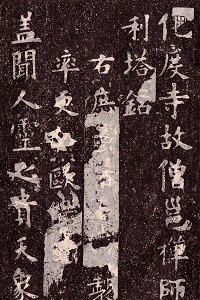 化度寺碑
化度寺碑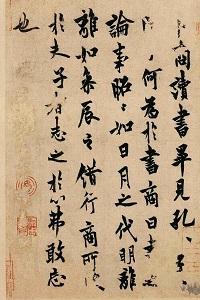 卜商帖
卜商帖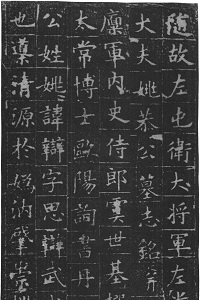 姚辯墓志
姚辯墓志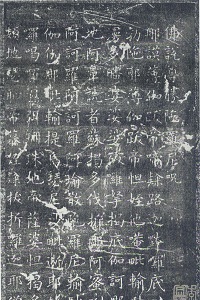 佛頂尊勝陀羅尼咒
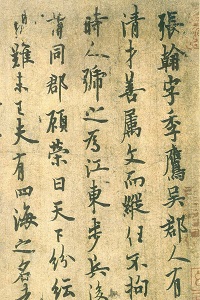 張翰帖
張翰帖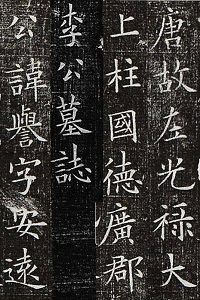 李譽墓志
李譽墓志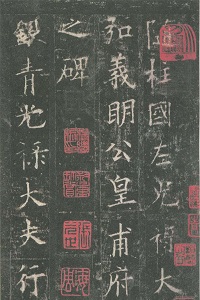 皇甫誕碑
皇甫誕碑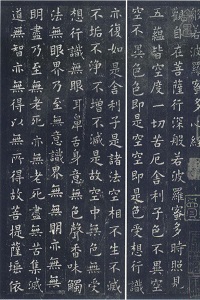 般若波羅蜜多心經
Timeline
- Born in Linxiang, Tanzhou, under Chen.[1][2]
- His father Ouyang He was executed; Ouyang escaped punishment and was adopted and educated by Jiang Zong. The precise year requires separate examination of his father’s case.[1]
- Became an erudite in the Court of Imperial Sacrifices, developing knowledge of classics, history and ritual.[1]
- Li Yuan had invited him into his circle; after Tang’s founding he held posts including supervising secretary.[1]
- Helped Pei Ju, Chen Shuda and others compile the hundred-volume 《藝文類聚》 on imperial order.[1]
- Became director of the Crown Prince’s Court and Hongwen Academy scholar, and Baron of Bohai.[1]
- Wrote 《九成宮醴泉銘》, composed by Wei Zheng.[3]
- Died. His son Ouyang Tong later became famous for continuing study of his father’s writing.[1]