Work titles are retained in Chinese; references link to the original sources.
Mi Fu(米芾)
Northern Song · 1051–1107 or 1108
Courtesy name Yuanzhang; also known as Mi Nangong. Artistic creation, collecting, authentication and criticism shaped his life. His running script is distinguished by changing brush movement.
Biography
Mi Fu, courtesy name Yuanzhang, traced his ancestry to Taiyuan, lived in Xiangyang and settled in Runzhou late in life. 《宋史》 says he entered service through his mother’s former attendance on Empress Dowager Xuanren. Local posts in Yongqiu, Lianshui and Wuwei were followed by appointments in imperial ritual, calligraphy and painting education, the Ministry of Rites and Huaiyang. Mi Nangong derives from office, not an artistic school. His official career differed from those of Su Shi and Huang Tingjian.[1][2]
Mi collected, authenticated and copied antiquities. 《宋史》 praises copies close to originals and describes persistent efforts to acquire old objects and art. Within transmission histories he could be creator, colophon writer, collector or copyist. Signatures, paper and provenance must be examined scroll by scroll; not every signed Mi work is an autograph.[1]
He studied the Two Wangs and Yan Zhenqing, particularly valuing Wang Xianzhi. The Palace Museum stresses changing brush handling and tilted structures. 《蜀素帖》, written in 1088 on valuable ruled silk, remains uninhibited within its boundaries. Several self-composed poems, corrections and a single-day date make it primary evidence for his middle years.[2][3]
Mi also painted and wrote criticism. 《宋史》 describes an individual manner in landscapes and figures. 《書史》 and 《畫史》 combine observations of old art, personal experience and aesthetic judgment. His son Mi Youren, the younger Mi, continued the family’s artistic practice, especially in ink landscapes. Mi participated in the formation of Northern Song collecting and criticism as well as calligraphy.[1][2]
Stories of extreme cleanliness, Tang-style clothing and bowing to strange rocks formed the eccentric Mi image. 《宋史》 also describes refusal to conform and repeated career difficulties. Rock anecdotes should not obscure local administration, court connoisseurship and art teaching. Under Huizong he viewed the imperial collection in Xuanhe Hall and wrote 《千字文》 on command.[1]
Death dates differ: Beijing adopts 1107, Taipei’s description of 《蜀素帖》 gives 1108. 《宋史》 reports an age of forty-nine, difficult to reconcile with the customary 1051 birth date. The later Four Song Masters grouping does not erase the different occasions represented by his letters, poetry scrolls, monuments and collectors’ colophons.[1][2][3][4]
Works and writings
- 《蜀素帖》: dated the twenty-third day of the ninth month of 1088; Taipei silk scroll, 27.8 × 270.8 cm. Self-composed poems and corrections occupy black ruled columns, yet structures remain varied. Text, date and material all provide evidence.[3]
- 《苕溪詩》, 《吳江舟中詩》 and 《虹縣詩》: catalogued by the Palace Museum as ink works. Comparison with 《蜀素帖》 shows differing structures and speeds in poetry scrolls.[5]
- 《研山銘》: a celebrated large-character scroll. After its return to China, scholars debated authenticity, mounting and colophons. The principal writing and attached material may belong to different periods.[6]
- 《書史》 and 《畫史》: texts of collecting and criticism essential to Mi’s views of antiquities and art, rather than individual calligraphic autographs.[1][2]
- An imperially commissioned 《千字文》 in small regular script modelled on 《黃庭經》: recorded in 《宋史》. The event belongs in a chronology, but cannot be described as an extant museum autograph without an identified original.[1]
Relationships
- Mi Youren: his son, accomplished in writing and painting. 《宋史》 records Mi Fu presenting his son’s 《楚山清曉圖》 to Huizong. They became the elder and younger Mi.[1]
- Huizong: appointed Mi to teach calligraphy and painting, permitted access to the imperial collection and commissioned writing.[1]
- Su Shi: a contemporary whose admiration for Mi’s poetry and prose is recorded in 《宋史》. Later included with Mi in the Four Song Masters.[1][2]
- Wang Anshi: admired Mi’s poetry and wrote it on a fan, according to 《宋史》. This does not establish calligraphic instruction.[1]
- Wang Xianzhi: an important earlier model, separated from Mi by several centuries.[1][3]
Assessment
- 《宋史》 describes Mi’s writing as grounded yet soaring, emphasising Wang Xianzhi’s influence, skilled copying and connoisseurship. Artistic ability and collecting judgment are assessed together.[1]
- Taipei describes 《蜀素帖》 as strongly influenced by Wang Xianzhi, graceful and open. Movement remains varied despite ruled boundaries; the assessment relates to the actual material and layout.[3]
- The Palace Museum notes strokes emerging in multiple directions, tilted structures and study of the Two Wangs and Yan. The eccentric Mi label does not explain decades of studying old works.[2]
- Emperor Gaozong, Zhao Gou, praised grounded, forceful cursive while expressing reservations about Mi’s regular, seal and clerical scripts. He warned that copying the outward exuberance could lose the underlying spirit of Six Dynasties writing. This is a complex early reception, rather than unqualified praise.[4]
- The Palace Museum publication 《米芾 故宮藏名跡與尺牘》 notes that his official and literary achievements differ from Su’s and Huang’s, while structure, brushwork and historical study establish comparable artistic standing. The Four Song Masters did not share identical careers or abilities.[4]
Related works(3)
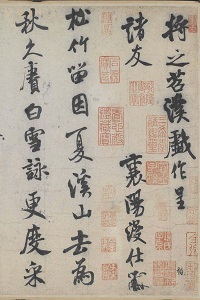 苕溪詩帖
苕溪詩帖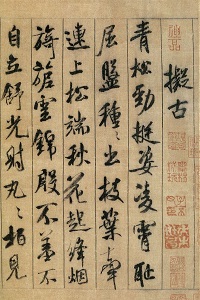 蜀素帖
蜀素帖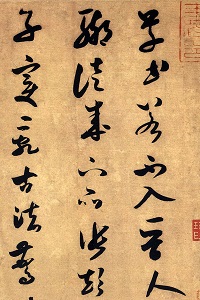 論草書帖
論草書帖Timeline
- Birth year adopted by both Beijing and Taipei museums.[2][3]
- Entered official service through his mother’s previous court connection and served in Yongqiu, Lianshui and elsewhere.[1]
- Wrote 《蜀素帖》 on the twenty-third day of the ninth month, as explicitly inscribed.[3]
- Served in calligraphy and painting education and the Ministry of Rites, and viewed the imperial collection.[1][2]
- Beijing gives 1107, Taipei 1108. The age recorded in 《宋史》 also requires caution.[1][2][3]