Work titles are retained in Chinese; references link to the original sources.
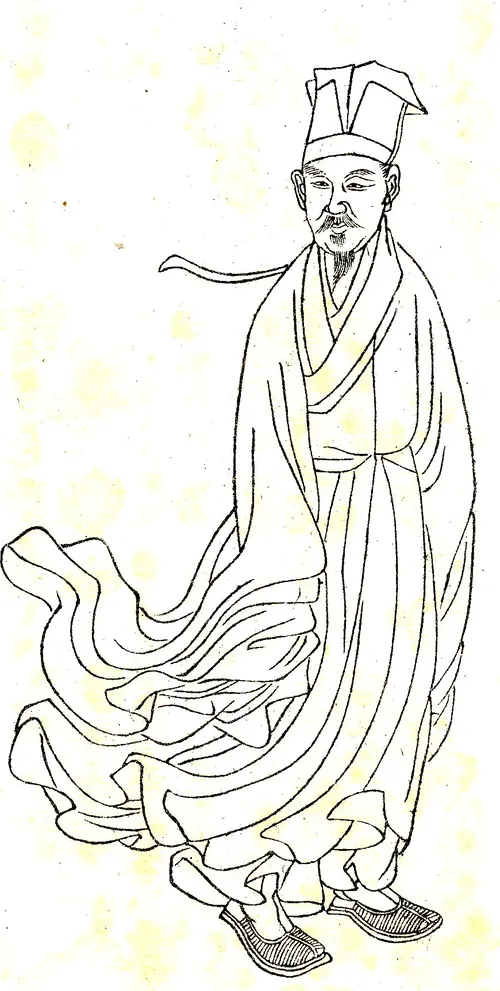
Huang Tingjian(黃庭堅)
Northern Song · 1045–1105
Courtesy name Luzhi; sobriquets Shangu Daoren and Fuweng. A native of Fenning, Hongzhou, he excelled in poetry and running and cursive scripts, developing his writing through years of political exile.
Biography
Huang Tingjian, courtesy name Luzhi, was born in Fenning, Hongzhou. His maternal uncle Li Chang tested his powerful childhood memory with books from his shelves. After passing the examination in 1067, Huang served as Yexian commandant, a teacher at the Northern Capital’s Directorate of Education and magistrate of Taihe. 《宋史》 particularly records his refusal to inflate salt-tax targets to please superiors, fearing a heavier burden on the population.[1]
Su Shi’s enthusiastic response to Huang’s writing spread his reputation. Under Zhezong he became a library collator and reviewer of 《神宗實錄》, later serving as imperial diarist and assistant director of the Palace Library. He personally cared for his seriously ill mother and guarded her grave after her death. Official and family life cannot be replaced by the single designation of one of Su’s Four Disciples.[1]
Early in Shaosheng, Zhang Dun and Cai Bian challenged passages in 《神宗實錄》. 《宋史》 says most of more than a thousand alleged faults proved supported by evidence. Questioned about a river-management passage, Huang maintained that he had witnessed the event. Exiled to Qianzhou and Rongzhou, he nevertheless taught visiting Sichuan scholars and continued poetry and calligraphy through hardship.[1]
After Huizong’s accession he briefly had prospects of return, then was excluded again as politics changed. 《荊南承天院記》 was accused of disparagement; he lost official status and was placed under supervision in Yizhou. He died in 1105, aged sixty-one, before learning of an order transferring him to Yongzhou. Late works span Rongzhou, Wuchang and Yizhou, rather than one uniform year or emotional state.[1][2]
His art exceeds large characters with elongated strokes. Taipei’s 《寒山子龐居士詩》 was a brush trial in Rongzhou around 1099–1100, amid arm pain, foot trouble and difficult living conditions. He composed 《松風閣詩》 during a Wuchang excursion in 1102; the surviving scroll may have been written later, but no later than 1105. These works differ in structure, brush and materials.[2][3]
Important regular-running, running and cursive works survive. The Palace Museum’s 《諸上座帖》 is a long cursive transcription of Chan discourse with corrections. Its continuous movement differs from the steadier composition of 《松風閣詩》. Huang studied Du Fu in poetry and earlier masters in writing while seeking independence. His colophon on Su’s 《寒食詩》 is both his own calligraphy and evidence of their friendship.[1][2][4][5]
Works and writings
- 《書寒山子龐居士詩》: a Taipei paper scroll written in Rongzhou around 1099–1100. It transcribes earlier authors, not Huang’s own poems. The museum notes losses in its latter section and substantial rounded lines marking a late stylistic development.[2]
- 《自書松風閣詩》: the poem dates to the 1102 Wuchang excursion, while the scroll may be later, no later than 1105. In the passage recalling the deceased Su Shi, Taipei observes tilted structures and increased stroke weight.[2][3]
- 《草書諸上座帖》: a long cursive scroll in the Palace Museum, transcribing Buddhist discourse with deletions and corrections. It shows his organisation of extended texts beyond regular-running script.[4]
- Colophon on 《黃州寒食詩》: appended to Su’s scroll, dated by Taipei no later than the ninth lunar month of 1100. It is both historical criticism and a calligraphic work transmitted with the original.[5]
Relationships
- Li Chang: his maternal uncle, whose testing of Huang’s childhood learning is recorded in 《宋史》.[1]
- Su Shi: admired his poetry, recommended him as a successor in office and received Huang’s colophon on 《寒食詩》.[1][5]
- Zhang Lei, Chao Buzhi and Qin Guan: later grouped with Huang as Su’s Four Disciples. Their literary association and patronage did not erase individual styles.[1]
- Chen Shidao: 《宋史》 cites his assessment that Huang learned from Du Fu without becoming a copy of him. This is literary criticism.[1]
- Zhang Dun and Cai Bian: leading officials who investigated 《神宗實錄》 in the Shaosheng reign, leading to Huang’s exile.[1]
- Zhao Tingzhi: had earlier disagreements with Huang; during his administration 《荊南承天院記》 was again treated as disparagement.[1]
Assessment
- 《宋史》 says Su Shi’s praise of Huang’s poetry as exceptionally outstanding greatly increased his fame. Su later recommended him for office, praising writing, filial devotion and friendship. This is contemporary literary and moral assessment.[1]
- Chen Shidao’s judgment that Huang learned from Du Fu without becoming Du Fu appears in 《宋史》. His poetic independence parallels the calligraphic movement from studying models to creating a personal manner.[1]
- 《宋史》 credits Huang with running and cursive writing and an independent regular method. The metaphor of long spears and great halberds misses a breadth of scripts already noted by the historian.[1]
- Taipei’s analysis of 《松風閣詩》 finds compact structures, long sweeping strokes and steady force together, with heavier brushwork in the passage about Su Shi. This concerns a specific scroll.[2][3]
- Taipei situates 《寒山子龐居士詩》 in his Rongzhou life and trial of a brush by Zhang Tong. Rounded, substantial lines suggest increased control. This assessment of 1099–1100 cannot be applied indiscriminately to early works.[2]
- Huang praises both poem and writing in Su’s 《寒食詩》, while his own large colophon creates a visual dialogue. Taipei describes their juxtaposition as two complementary excellences. Mutual assessment explains their exchange more specifically than a general claim of equal fame.[5]
Related works(9)
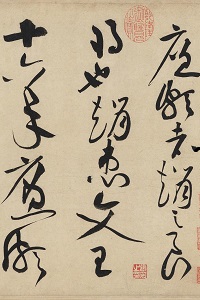 廉頗藺相如列傳
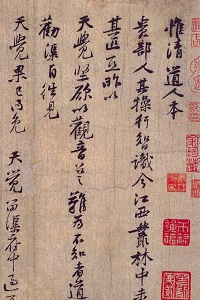 惟清道人帖
惟清道人帖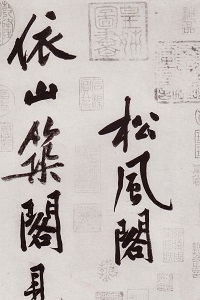 松風閣帖
松風閣帖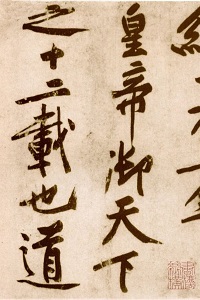 砥柱銘
砥柱銘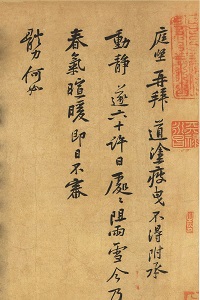 荊州帖
荊州帖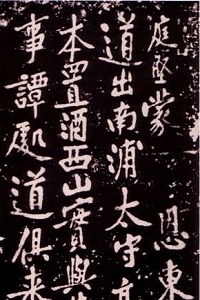 西山南浦行記
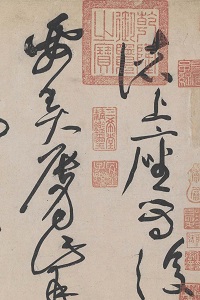 諸上座草書卷
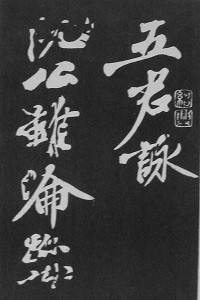 五君詠
五君詠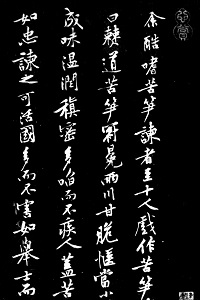 苦筍帖
苦筍帖Timeline
- Born in Fenning, Hongzhou.[1]
- Passed the examination and subsequently held local and educational offices.[1][4]
- Helped compile 《神宗實錄》 and served as library collator, imperial diarist and other posts.[1]
- Investigated over passages in 《神宗實錄》 and exiled to Qianzhou and Rongzhou.[1]
- Tried a new brush in Rongzhou while writing 《寒山子龐居士詩》.[2]
- Added the colophon to Su Shi’s 《寒食詩》 scroll.[5]
- Composed 《松風閣詩》 on a Wuchang excursion; the scroll may have been written slightly later.[2][3]
- Died under supervision in Yizhou. The 《松風閣詩》 scroll had been completed by this time.[1][3]