Work titles are retained in Chinese; references link to the original sources.
Chu Suiliang(褚遂良)
Tang · 596–658 or 659
Courtesy name Dengshan. A senior official under Taizong and Gaozong, he developed clear, vigorous and flowing monumental regular script from the tradition of Wang Xizhi.
Biography
Chu Suiliang was the son of Chu Liang. He accompanied his father to Longyou at the end of Sui and served as a court interpreter under the regional ruler Xue Ju. After Tang defeated Xue, he entered the Qinzhou military administration. His early experience included local politics during the dynastic transition, rather than merely writing court monuments. In 636 he moved from secretary to imperial diarist, recording the ruler’s words and actions.[1]
《舊唐書》 describes broad literary and historical knowledge and accomplished calligraphy. Ouyang Xun, a friend of his father, held him in high regard. After Yu Shinan died, Wei Zheng recommended Chu to Taizong for vigorous writing in Wang Xizhi’s manner. The emperor summoned him as an attendant calligrapher. As the court acquired Wang works, Chu assessed their origins individually. His early reputation united brushwork, connoisseurship and court service.[1]
As imperial diarist and remonstrating official, Chu repeatedly advised Taizong. He opposed an ill-timed pilgrimage and sacrifice at Mount Tai, insisted that historians record both good and bad royal conduct, and discussed the status and education of princes, campaigns in Korea and garrisons in the Western Regions. These arguments occupy much of his biography in 《舊唐書》 and are essential to his life. An account limited to fine writing followed by exile erases this political practice.[1]
When Crown Prince Chengqian was deposed in 643, Chu warned against favouring Li Tai at the expense of Li Zhi’s safety. Li Zhi became crown prince. In 649 the dying Taizong entrusted affairs to Chu and Zhangsun Wuji, and Chu drafted related edicts. Under the new emperor Gaozong he held leading offices including director of the Secretariat, Minister of Personnel and right vice-director of the Department of State Affairs.[1]
《雁塔聖教序》 arose in this political and religious setting. Taizong wrote 《大唐三藏聖教序》 for Xuanzang’s translations, and Crown Prince Li Zhi composed 《述聖記》. Chu supplied the calligraphy in 653 for two stones installed at the Great Wild Goose Pagoda in Ci’en Monastery, Chang’an. This mature achievement involved emperors, Buddhist institutions, translation work and public space. Palace Museum research particularly examines its political and material circumstances.[3]
In 655 Gaozong sought to depose Empress Wang and install Consort Wu. Chu vehemently protested, invoking Taizong’s final charge and the empress’s lack of wrongdoing. Dismissed from court, he was sent to Tanzhou, then Guizhou and Aizhou. 《舊唐書》 records death in Aizhou, subsequent removal of titles and exile of descendants, followed by restoration in the Shenlong reign. His death is variously dated 658 or 659 in chronologies and museum records.[1][2]
His monumental writing changed over time. 《伊闕佛龕碑》 of about 641 and 《孟法師碑》 of about 642 show earlier approaches; Palace Museum research identifies 《雁塔聖教序》 as a late culmination of skill and historical opportunity. Treating the Chu style as a fixed thin manner from youth to old age obscures his adjustments of strokes and space across monuments.[3]
Works and writings
- 《伊闕佛龕碑》: written around 641, showing earlier monumental regular script. Palace Museum research compares it and 《孟法師碑》 with 《雁塔聖教序》.[3]
- 《孟法師碑》: written around 642. Together with 《伊闕佛龕碑》 it informs study of his developing style, chiefly through stone monuments and rubbings.[3]
- 《雁塔聖教序》 and 《述聖記》: written in 653 for two stones at Ci’en Monastery’s Great Wild Goose Pagoda, carrying Taizong’s and Gaozong’s texts respectively. Writing, carving, placement and later impressions all belong to their history.[3]
- Attributed 《倪寬贊》: praised in historical colophons and richly documented in collections. An attribution remains an attribution; confidence expressed by later admirers must not become a claim of undisputed modern authentication.[4]
- Attributed copies of 《蘭亭序》 and 《大字陰符經》: works associated with Chu encompass complex categories of copying, traced copies, later misattributions and monumental rubbings. Each requires separate examination.[2][4]
Relationships
- Chu Liang: his father, a Sui and Tang official, whom he accompanied to Longyou.[1]
- Ouyang Xun: an old friend of his father who admired him. The historical statement of high regard does not prove a formal apprenticeship.[1]
- Yu Shinan and Wei Zheng: after Yu’s death, Wei recommended Chu as Taizong’s attendant calligrapher.[1]
- Taizong: his ruler, who asked him to authenticate acquired Wang Xizhi works and received his historical records and some of his remonstrances.[1]
- Zhangsun Wuji: jointly received Taizong’s final charge with Chu; both attended deliberations over Gaozong’s change of empress.[1]
- Gaozong, Li Zhi: Chu supported his appointment as crown prince and advised him as emperor, before a severe conflict over the empress’s deposition.[1]
- Xuanzang: his translation enterprise occasioned 《雁塔聖教序》. Taizong and Gaozong composed the texts and Chu wrote them; Xuanzang was not his calligraphy teacher.[3]
Assessment
- 《舊唐書》 records Wei Zheng’s praise of vigorous brushwork capturing Wang Xizhi’s structures when recommending Chu to Taizong. This court-related assessment explains his early reputation more precisely than general praise of elegance.[1]
- Ouyang Xun held Chu in high regard, and the histories describe his ability to identify authenticity and provenance when Taizong acquired Wang works. Recognition concerned connoisseurship and documentary judgment as well as writing.[1]
- Zhang Huaiguan’s 《書斷》 places Chu’s clerical and running writing in the excellent category. Tang usage of clerical script differs from the modern Han-clerical classification. The ranking also shows that Tang viewers knew more than the regular script of 《雁塔聖教序》.[5]
- 《石渠寶笈》 preserves colophons on 《倪寬贊》 by Zhao Mengjian, Yang Shiqi and others. Zhao valued ease and smooth flow; Yang invoked gold arising within characters and jade lustre between columns to praise refined fluency. These comments concern an attributed ink work and do not themselves establish authorship.[4]
- Palace Museum research treats 《雁塔聖教序》 as a late peak tied to the emperors’ texts, Xuanzang’s translations and the installation at Ci’en Monastery. Text, location, stone, rubbings and stylistic development should be considered together.[3]
Related works(3)
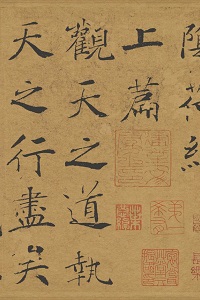 大字陰符經
大字陰符經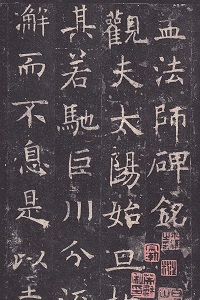 孟法師碑
孟法師碑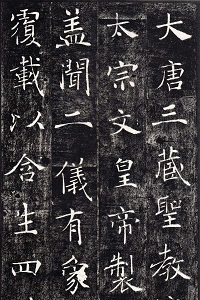 雁塔聖教序
雁塔聖教序Timeline
- Commonly accepted birth year.[2]
- Accompanied Chu Liang to Longyou, served under Xue Ju and later entered Tang’s Qinzhou administration.[1]
- Moved from secretary to imperial diarist and recorded court affairs.[1]
- Approximate date of 《伊闕佛龕碑》. Also advised Taizong against the Mount Tai sacrifice.[1][3]
- Approximate date of 《孟法師碑》.[3]
- Participated in succession deliberations which established Li Zhi as crown prince.[1]
- Received Taizong’s final charge with Zhangsun Wuji and assisted the newly enthroned Gaozong.[1]
- Wrote 《雁塔聖教序》 and 《述聖記》 for two stones at the Great Wild Goose Pagoda.[3]
- Opposed replacing Empress Wang with Consort Wu and was subsequently sent away from court.[1]
- Died in Aizhou. Historical and museum conversions of the date differ.[1][2]
- Restoration of offices and titles during the Shenlong reign constituted posthumous political rehabilitation.[1]