Work titles are retained in Chinese; references link to the original sources.
Emperor Huizong (Zhao Ji)
Northern Song · 1082—1135
Northern Song emperor, calligrapher, painter and court patron. Known for Slender Gold regular script as well as cursive works, he shaped collecting and artistic training before ending his life in captivity after the Jingkang catastrophe.
Biography
Zhao Ji (1082–1135), Emperor Huizong, was the eleventh son of Emperor Shenzong and Lady Chen, later honoured as Empress Qinci. Before his accession he held the titles Prince of Suining and Prince of Duan. He was Emperor Zhezong’s younger brother, not his son. His imperial background shaped both his education and his later command of the court’s collecting, artistic production and connoisseurship.[1][3]
In 1100 Zhezong died without a surviving son to succeed him, and Zhao Ji became emperor. 《宋史》 describes Empress Dowager Xiang’s role in the succession and Zhang Dun’s opposition to the Prince of Duan. Written with knowledge of the Northern Song collapse, this account carries a retrospective political judgement. The succession itself should be distinguished from the later verdict on his reign.[1][2]
His reign used the era names Jianzhong Jingguo, Chongning, Daguan, Zhenghe, Chonghe and Xuanhe. Appointments, factional conflict, institutional changes and palace projects were connected with court education, collecting and the circulation of imperial writing. Cai Jing’s repeated rise and dismissal exemplify the political setting of these activities. Huizong’s reign cannot be adequately described as the life of an artistic sovereign alone.[1][11][2]
His most recognisable calligraphy is Slender Gold. The Palace Museum traces its models to Chu Suiliang, Xue Yao and Xue Ji, whose Tang regular script he transformed. This was study of earlier models, not personal instruction by those artists. Slender Gold remains regular script; line width needs to be considered together with pressure, turns and structure.[4]
His writing extends beyond Slender Gold. Works transmitted under his name include regular-script poems, inscriptions on paintings and long cursive scrolls. Handscrolls, album leaves and colophons call for different arrangements. The cursive Thousand Character Classic should not be labelled Slender Gold, nor should different works sharing the title Thousand Character Classic be merged.[5][6][7][10]
His court assembled major collections of earlier calligraphy and painting. The Xuanhe catalogues belong to a court system of collecting, classification and assessment that became important to later provenance studies. These were court compilations rather than necessarily texts personally written in full by the emperor. Historical catalogue attributions do not authenticate every surviving object that bears the same title.[3]
Cai Jing’s colophon to 《千裡江山圖》 and related scholarship illuminate Huizong’s connection with the young painter Wang Ximeng. The Palace Museum describes Wang’s court training, presentation of paintings and imperial instruction. This shows Huizong’s role in artistic patronage. Wang’s later life is poorly documented, and imperial instruction is not evidence that Huizong painted the work for him.[9]
Late in his reign, cultural achievement coexisted with grave political and military crises. 《宋史》 sharply criticises extravagant projects, reliance on favoured ministers and military ventures, and discusses relations with Jin and Liao in explaining the loss of the state. These judgements matter to his historical image, while assessing a poem’s brushwork and an emperor’s political responsibility require different evidence.[2]
At the end of Xuanhe 7, as Jin forces advanced, Huizong abdicated in favour of Crown Prince Zhao Huan and became retired emperor. In the Gregorian calendar this was early 1126, so the era year must not be mechanically equated with a Gregorian year. Kaifeng subsequently fell during the Jingkang crisis, and both emperors were taken north. The imperial family and court collections underwent a profound rupture.[2]
He died in northern captivity in 1135. His annals culminate in the loss of the state, while later collectors and historians repeatedly reassessed his artistic standing. His political failure does not erase his artistic contribution, and artistic accomplishment does not remove political responsibility. His roles as emperor, calligrapher, painter, collector and patron need to be examined through specific works and records.[2][3]
Works and writings
- 《楷書千字文卷》, Thousand Character Classic in regular script: held by the Shanghai Museum. It is distinct from the cursive scroll in the Liaoning Provincial Museum; a shared text does not mean a shared script, format or date.[5][10]
- 《詩帖》, also known as 《穠芳詩帖》: a regular-script poem on silk in the National Palace Museum. The museum discusses its large characters; images and transcription allow comparison of fine lines, turns and stroke endings at this scale.[6]
- The poems 《欲借》 and 《風霜》: Huizong’s writing in the National Palace Museum’s first album of Song calligraphy. They are separate from the Nongfang Poetry Scroll. The collection transcription helps distinguish titles and study regular script at album-leaf scale.[7]
- 《閏中秋月詩帖》: a regular-script poem included in the Palace Museum’s Song and Yuan calligraphy album. The album contains works by several artists; its full extent and contents must not all be attributed to Zhao Ji.[8]
- 《草書千字文》: the cursive Thousand Character Classic in the Liaoning Provincial Museum. Palace Museum scholarship contrasts its flowing turns with the emphatic articulation of the Nongfang scroll. It is evidence for Huizong’s cursive writing, not an example of Slender Gold regular script.[10]
- 《宣和書譜》 and 《宣和畫譜》: court catalogues preserving classifications, assessments and provenance information for earlier works. They belong to the Xuanhe collecting enterprise and should not be treated in their entirety as Huizong’s personal prose.[3]
Relationships
- Emperor Shenzong and Lady Chen: his father and mother. 《宋史》 identifies him as Shenzong’s eleventh son; Chen was later honoured as Empress Qinci.[1]
- Emperor Zhezong and Empress Dowager Xiang: Zhezong was his elder brother; Xiang helped determine the succession. She was not Huizong’s birth mother.[1]
- Emperor Qinzong, Zhao Huan: his son and successor, who faced the Jin advance and the Jingkang crisis after the abdication.[2]
- Cai Jing: an influential minister involved in government and factional politics, also active in court art through calligraphy and colophons. His colophon to 《千裡江山圖》 is important evidence for Wang Ximeng’s connection with Huizong.[2][9]
- Wang Ximeng: a young court painter who received imperial instruction. His work illustrates patronage and artistic training; later legends should not be used to fill the gaps in his biography.[9]
- Chu Suiliang, Xue Yao and Xue Ji: earlier Tang models associated with Slender Gold. They were sources of stylistic study, not living teachers of Huizong.[4]
- Tong Guan and Zhao Liangsi: figures connected with late-reign military affairs and negotiations with Jin. 《宋史》 includes their actions in its explanation of the collapse; the historian’s causal judgement should be recognised as such.[2]
Assessment
- The Palace Museum situates Slender Gold as a transformation of Tang models. Its individuality lies not only in fine lines but in the articulation of turns and the tension of its structures.[4]
- The National Palace Museum discusses specific stroke endings, diagonal strokes and hooks in the Poetry Scroll. Attention to these details reveals more than a general label such as thin and hard.[6]
- Palace Museum scholarship juxtaposes emphatic articulation in his regular script with speed and turning movement in cursive. Script, material and scale affect the rhythm of each work.[10]
- The concluding judgement in 《宋史》 centres on appointments, extravagance, religious activity and political and military failure. It is a political assessment, not an authentication of individual artworks.[2]
- As emperor he influenced collecting, training and transmission as well as calligraphic style. Personal brushwork, inscriptions, court production and later copies need to be distinguished; an imperial attribution is not a substitute for examining the individual object.[3][9]
Related works(1)
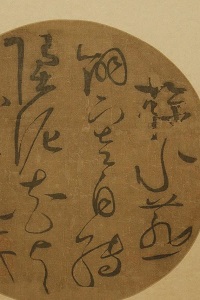 草書紈扇
Timeline
- Born as the eleventh son of Emperor Shenzong.[1]
- Held the titles Prince of Suining and Prince of Duan.[1]
- Succeeded Zhezong as emperor.[1]
- Adopted the Jianzhong Jingguo era name.[1]
- The Chongning era began; Cai Jing became a central political figure.[1]
- Court art, collecting and cataloguing developed during his reign.[3][11]
- Abdicated in favour of Zhao Huan as Jin forces advanced.[2]
- Huizong and Qinzong were taken north by the Jin during the Jingkang catastrophe.[2]
- Died in northern captivity.[2]
- His works underwent collecting, cataloguing and reassessment alongside debate over his political failure.[2][3][6]
References
- 《宋史》, vol. 19: Huizong, part 1
- 《宋史》, vol. 22: Huizong, part 4 and historical assessment
- Palace Museum: Zhao Ji
- Palace Museum: Slender Gold style
- Shanghai Museum: Chinese calligraphy gallery, including 《楷書千字文卷》
- National Palace Museum: Huizong’s Poetry Scroll
- National Palace Museum: Huizong’s poems in the Song calligraphy album
- Palace Museum: Song and Yuan calligraphy album, including 《閏中秋月詩帖》
- Palace Museum: Wang Ximeng
- Palace Museum Journal: 《裴將軍詩》 and the Song reception of Yan Zhenqing
- 《宋史》, vol. 20: Huizong, part 2