Work titles are retained in Chinese; references link to the original sources.
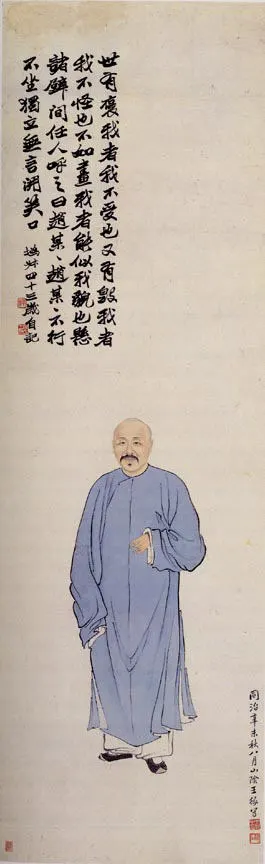
Zhao Zhiqian(趙之謙)
Qing · 1829–1884
Courtesy names Yifu and Huishu; sobriquets including Bei’an; a native of Kuaiji, Zhejiang. Inscription and character studies, calligraphy, painting and seal carving developed together, advancing monument-based approaches across scripts.
Biography
Zhao was born in Kuaiji, Zhejiang, using courtesy names Yifu and Huishu and sobriquets including Lengjun, Bei’an and Wumen. He passed the provincial examination in the Xianfeng reign and later served as magistrate in Poyang, Fengxin and other Jiangxi counties. His modest official career unfolded amid warfare and local duties alongside writing, inscription study, carving and painting. Either a solely Shanghai-painter or solely seal-carver label misses central calligraphic and epigraphic work.[1][3]
He began with Yan Zhenqing, then deeply studied northern monuments; Deng Shiru and Wu Rangzhi informed seal and clerical writing. Contemporary assessment cited by the Palace Museum links his understanding of Bao Shichen’s brush theory with a synthesis of seal, clerical, regular and running scripts. Studying these traditions does not prove personal instruction from every earlier master.[1][4]
《六朝別字》 and 《補寰宇訪碑錄》 organise variant characters and inscriptions, providing knowledge alongside direct copying. His monument-based practice sought structures and movement across inscriptions, old seals and scripts rather than merely angular strokes. Shanghai sees comprehensive study across scripts as crucial to Qing stylistic transformation.[1][2]
The four-script scroll of 1869 and Beijing’s 《篆書鐃歌冊》 demonstrate range. The latter renders ancient Music Bureau texts through seal script combining northern, Qin–Han and clerical elements. Paper album leaves differ materially from carved stones and rubbings. His seals also exploit spacing, old characters and monument headings, a process Shanghai describes as seeking seals beyond seals.[3][4][5]
Zhao’s flower painting applies lines and structures from writing and carving. This interaction influenced Wu Changshuo and later artists. Fame also encouraged forged seals and signatures. Palace Museum research identifies false attributions through inscription lettering, cutting and layout. A title or seal legend alone cannot authenticate an exhibited work.[1][5][6]
He died in 1884. Reputation circulating among scholars, officials and seal artists extended into Shanghai and modern inscription-based art. Hu Shu’s praise of wide learning and the museum’s placement of Zhao as a Shanghai-school precursor emphasise different aspects of the same creative interaction between philology, seals, writing and painting.[1][5]
Works and writings
- 《篆書鐃歌冊》: Palace Museum; ancient Music Bureau texts in seal writing combining monumental and clerical ideas, revealing paper-based lines and structures.[4]
- Four-script hanging scroll dated 1869: Shanghai Museum; regular, clerical, running and seal forms offer securely dated comparison within one object.[3]
- 《六朝別字》 and 《補寰宇訪碑錄》: epigraphic and philological publications, rather than individual calligraphic autographs.[1]
- Seals and albums: surfaces draw on monuments, roof tiles and ancient seals. Stones, side inscriptions and reliable albums must be checked together for authenticity.[5][6]
Relationships
- Deng Shiru and Wu Rangzhi: earlier models in seal, clerical and carving traditions; study must be distinguished from personal teaching.[1][4]
- Yan Zhenqing: the Tang master whom Zhao studied early.[1]
- Bao Shichen: an earlier theoretician whose brush-method insights Zhao absorbed.[1]
- Hu Shu: a contemporary scholar who explicitly assessed Zhao’s learning and multiple arts.[5]
- Wu Changshuo: a later artist inspired by Zhao’s experiments, rather than a directly taught disciple.[1][5]
Assessment
- The Palace Museum cites contemporary assessment of a progression from Yan toward northern inscriptions and unified methods across scripts, with changing forms. This concerns learning and synthesis.[1]
- Shanghai calls Zhao exemplary in comprehensive Qing monument study and credits his development of northern-monument techniques, focusing on practice rather than slogans.[2]
- Hu Shu praised exceptional gifts and broad learning; Shanghai connects this with painting, carving, writing and philology. Assessment cannot be confined to one art.[5]
- Beijing’s analysis of 《篆書鐃歌冊》 identifies northern inscriptions, Qin–Han characters and clerical handling within seal script. This explains formation more precisely than a generic epigraphic spirit.[4]
- Museum research on forged Zhao seals stresses lines, cutting, side inscriptions and legends. Authentication should precede assessment of an individual work’s quality.[6]
Related works
Timeline
- Born in Kuaiji, Zhejiang.[1][3]
- Passed the provincial examination, later serving as magistrate in Poyang, Fengxin and elsewhere in Jiangxi.[1]
- Moved from Yan models toward northern monuments and investigated Six Dynasties characters and inscription records.[1][2]
- Wrote the four-script scroll now in Shanghai Museum.[3]
- Developed writing, painting and seals together, applying inscription methods and characters across scripts.[1][2][5]
- Died, leaving an influence on late-Qing and modern Shanghai art and seals.[1][5]