Work titles are retained in Chinese; references link to the original sources.
Zhu Yunming(祝允明)
Ming · 1460–1526; some records give 1527
Courtesy name Xizhe; sobriquet Zhishan; a native of Changzhou. He served as Xingning magistrate and assistant prefect of Yingtian in middle age, and excelled in meticulous small regular as well as freely expansive cursive writing.
Biography
Zhu Yunming, courtesy name Xizhe and sobriquet Zhishan, came from Changzhou. Six fingers on one hand inspired another sobriquet, Zhizhisheng. He passed the provincial examination in 1492 but repeatedly failed the metropolitan examination. 《明史》 nevertheless records service as Xingning magistrate and Yingtian assistant prefect before retirement through illness. The title Zhu Jingzhao derives from office; fame in writing did not erase examination setbacks and local service.[1][2]
Zhu belonged to Suzhou’s literary community with Wen Zhengming, Tang Yin and Xu Zhenqing. Poems, exchanges and requests for calligraphy occurred within this circle. Palace Museum accounts of Tang Yin describe Zhu urging him back to study after repeated family bereavements. This personal episode is more informative than the group name of the Four Wu Talents.[1][2]
His models were broad. The Palace Museum identifies Zhong Yao, the Two Wangs, Yu Shinan and Chu Suiliang in regular script; the Two Wangs and Su Shi in running; Zhang Xu, Huaisu and traces of early cursive in cursive writing. Early small regular 《唐宋四家文》, mature 《三體雜書詩》 and late large cursive works differ without implying different authors. His wild-cursive reputation must not obscure disciplined small regular training.[2][3][6]
《三體雜書詩》 juxtaposes regular, running and cursive scripts in one scroll. The Palace Museum notes rigorous regular forms, fluent running and soaring cursive, some retaining early-cursive methods. This range demonstrates old principles and transformation better than an isolated wild-cursive image. His texts include Tang–Song writing, his own poems and social commissions.[3]
Multiple works survive in Beijing and Shanghai. Shanghai’s analysis of 《牡丹賦》 identifies Zhang Xu, Huaisu and Huang Tingjian as influences while emphasising greater abandon. It calls 《前後赤壁賦》 a representative late work. Provincial service around 1514 and later birthday poems provide anchors for chronology.[2][4][5][7]
Beijing generally gives 1460–1526, whereas Shanghai records also give 1460–1527. Chronologies and catalogues differ on his death year. Dates of particular works must still follow their individual inscriptions.[2][7]
Works and writings
- 《唐宋四家文》: early small regular script in the Palace Museum, dated through its inscription to 1487. It provides a starting point for comparison with later wild cursive.[2][6]
- 《三體雜書詩》: Palace Museum paper scroll, 28.5 × 739.2 cm, combining regular, running and cursive scripts, with early-cursive elements in some smaller cursive writing.[3]
- 《行書七律壽礪庵詩》: the Palace Museum identifies it as a birthday poem for Mao Cheng commissioned by Xie Yuanhe when Zhu was sixty-four. It shows running script in a social setting.[4]
- 《草書前後赤壁賦》 and 《牡丹賦》: separate Shanghai Museum scrolls. The former transcribes Su Shi’s prose in cursive; specific holdings must be identified before stylistic comparison.[5][7]
Relationships
- Wen Zhengming and Wang Chong: grouped with Zhu as the Three Wu Calligraphers. Wen was a contemporary friend, Wang a younger master.[2]
- Tang Yin: a literary friend encouraged by Zhu after family misfortune.[2]
- Xu Zhenqing: grouped with Zhu, Wen and Tang as the Four Wu Talents, chiefly reflecting their literary community.[1][2]
- Zhang Xu, Huaisu and Huang Tingjian: earlier cursive models, separated from Zhu by centuries.[2][7]
- Xie Yuanhe and Mao Cheng: commissioner and recipient of a Palace Museum birthday-poem hanging scroll, identifying a specific social occasion.[4]
Assessment
- 《明史》 places Zhu in its literary biographies, recording poetry, examination history and official service. This supplies historical context for the talented-literatus image.[1]
- The Palace Museum cites Ming praise of his command of Jin–Wei traditions and increasingly extraordinary late freedom, including the claim of first place in the dynasty. This is contemporary admiration, not a self-evident objective ranking.[2]
- The Palace Museum finds rigorous regular script, fluent running and soaring cursive together in 《三體雜書詩》, correcting a purely wild image.[3]
- Shanghai analyses 《牡丹賦》 through earlier influences and greater exuberance, and 《前後赤壁賦》 through free brushwork and slanting momentum. Both assessments concern identified scrolls.[5][7]
- The Three Wu Calligraphers grouping places Zhu, Wen and Wang within differing developments of regional Ming writing. Their methods and lives were not identical.[2]
Related works(6)
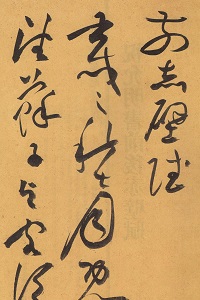 前後赤壁賦
前後赤壁賦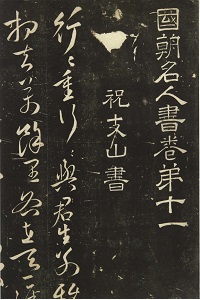 古詩十九首
古詩十九首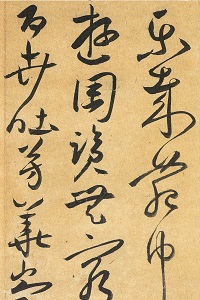 嵇康酒會詩
嵇康酒會詩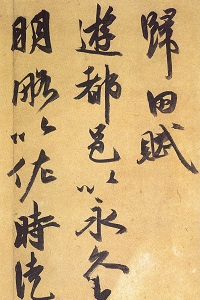 歸田賦
歸田賦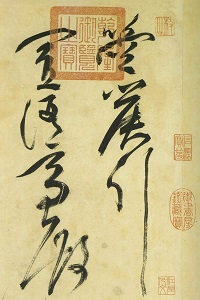 曹植樂府詩四首
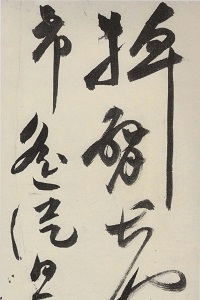 自書詩卷
自書詩卷Timeline
- Commonly accepted birth year; born in Changzhou.[1][2]
- Wrote the small regular 《唐宋四家文》 scroll.[6]
- Passed the provincial examination; subsequent metropolitan attempts failed.[1][2]
- Appointed magistrate of Xingning, Guangdong; later served in Yingtian.[2]
- At sixty-four, wrote the hanging scroll 《行書七律壽礪庵詩》.[4]
- Death dates differ between Beijing and Shanghai museum records.[2][7]