Work titles are retained in Chinese; references link to the original sources.
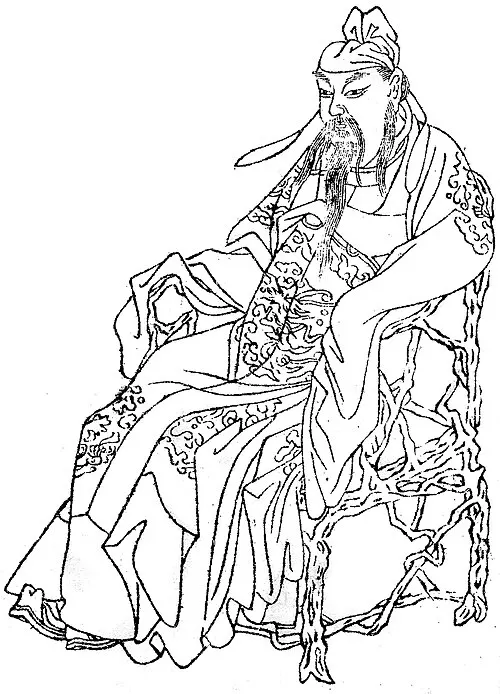
Yan Zhenqing(顏真卿)
Tang · 709–784 or 785
Courtesy name Qingchen. He organised resistance at Pingyuan during the An Lushan Rebellion and was killed late in life while on a mission to Li Xilie’s army. Both his regular and running scripts became models for later generations.
Biography
Yan Zhenqing, courtesy name Qingchen, came from the Yan clan of Linyi, Langya. 《舊唐書》 describes him as a diligent young scholar, gifted in writing and calligraphy, who passed the metropolitan examination during the Kaiyuan era and served in censorial offices. It recounts his prompt resolution of a long-standing wrongful case at Wuyuan and his impeachment of an official for improper conduct. From the outset he was a public official concerned with administration and ritual propriety. Calligraphy was important to his life, but it was not its only thread.[1]
Because Yan refused to attach himself to Chancellor Yang Guozhong, he was sent away from court to serve as Governor of Pingyuan. Suspecting An Lushan’s preparations for rebellion, he used heavy rain as a reason to repair the city walls and deepen the moat, while discreetly counting able-bodied men and storing grain. Banquets and poetry gatherings concealed these measures. When rebellion broke out in 755 and districts across Hebei fell rapidly, Pingyuan could defend itself because of its earlier preparations. Yan reported to the court, recruited troops and gained the support of neighbouring districts. His reputation for resistance grew from this specific military and local organisational work.[1]
His older paternal cousin Yan Gaoqing, Governor of Changshan, joined the resistance with his son Yan Jiming; they were killed after the city fell. Yan Zhenqing sent his eldest nephew Yan Quanming to deal with the aftermath, and remains were eventually recovered. 《祭侄文稿》 is the draft of a sacrificial text for Jiming. It commemorates both a family member and the family’s devastating experience of war. The National Palace Museum, Taipei, interprets phrases about the father’s capture and the son’s death through the text and historical events.[2]
After the rebellion Yan continued to serve under Emperors Suzong, Daizong and Dezong, experiencing repeated transfers and demotions. 《舊唐書》 records his arguments over wording in ritual texts and his opposition to Chancellor Yuan Zai’s requirement that officials report through successive administrative levels before addressing the emperor. He feared that this would close off frank advice. He also participated in court ritual affairs in later life. An account limited to resistance at Pingyuan, mourning his nephew and dying for his principles would omit decades of political activity.[1]
When the rebel commander Li Xilie established an independent power base, Chancellor Lu Qi proposed sending Yan to persuade him to submit. Although elderly, Yan entered the rebel camp on imperial orders and refused a position offered by the rebels despite weapons, pressure to surrender and threats of death. 《舊唐書》 describes his preparation of a final memorial, an epitaph and sacrificial texts during captivity, before he was killed. His death is dated to either 784 or 785: 《舊唐書》 gives the third day of the eighth month of the first Xingyuan year, while the Palace Museums in Taipei and Beijing adopt 785. Problems of calendar conversion and conflicts among Tang epitaphs and biographical accounts should be presented together.[1][2][3][6]
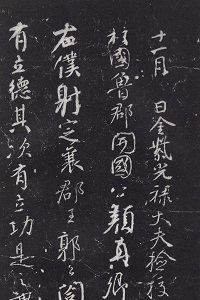
Yan’s calligraphy changed over time. 《多寶塔碑》 of 752 has rigorously ordered strokes, while 《顏勤禮碑》 and 《麻姑仙壇記》 show the breadth of his mature regular script. 《祭侄文稿》 of 758 is a draft mourning his nephew; 《爭座位稿》 of November 764 is a draft letter to Guo Yingyi criticising arrangements for seating at court. These two running-script works arose in different circumstances. Their revisions, pauses and changes in ink also differ from the carefully ordered writing of formal inscriptions.[2][3][5][8]
From the Song onward, Yan’s calligraphy was repeatedly associated with his steadfast moral character. Su Shi placed him alongside Du Fu, Han Yu and Wu Daozi, and the National Palace Museum, Taipei, notes that 《祭侄文稿》 is often used to illustrate the idea that writing reflects its author. This history of reception matters, but individual lines, turns and composition must still be analysed through the works themselves. Moral praise cannot replace observation of form.[2][4]
Works and writings
- 《多寶塔碑》: a temple inscription written in 752. The monument and rubbings are evidence for Yan’s earlier regular script; it should not be treated as the single fixed form of his style throughout his life.[3][5]
- 《祭侄文稿》: a draft sacrificial text written for his nephew Yan Jiming in 758, preserved on paper at the National Palace Museum, Taipei, measuring 29.2 cm high by 59.6 cm wide. Its corrections, changing ink tones and evidence of drafting remain visible. The museum identifies it as an important surviving autograph.[2][7]
- 《爭座位稿》: a draft letter to Guo Yingyi from November 764, criticising the seating of the eunuch Yu Chao’en above ministers. It is now encountered through rubbings, which must be distinguished from the original draft and its stages of transmission.[8]
- 《顏勤禮碑》《麻姑仙壇記》: representative works of mature regular script. The former is a family funerary stele; the latter is a Daoist inscription. Their scale, purposes and the condition of their rubbings cannot be merged into a single work.[3][5]
- 《顏家廟碑》: an inscription composed and written for the Yan family in his later years. It brings together family memory, literary cultivation and the forms of regular script.[3]
Relationships
- Yan Gaoqing: an older paternal cousin and Governor of Changshan, killed while resisting An Lushan. His son Yan Jiming is the person mourned in 《祭侄文稿》.[1][2]
- Yan Quanming: Gaoqing’s eldest son and Yan Zhenqing’s nephew, entrusted with searching for the remains of Gaoqing and Jiming.[2]
- Yang Guozhong: chancellor under Emperor Xuanzong. He sent Yan to Pingyuan because Yan refused to become his follower.[1]
- An Lushan: leader of the rebellion. Yan organised the defence of Pingyuan and coordinated resistance with neighbouring districts.[1]
- Huaisu: Lu Yu’s 《僧懷素傳》 records their discussion of cursive brushwork and an insight associated with summer clouds. Their calligraphic contact has a documentary basis.[8]
- Yuan Zai and Lu Qi: political adversaries in his later years. Yan opposed Yuan’s restrictions on direct memorials; Lu recommended sending him to Li Xilie.[1]
- Li Xilie: the rebel commander who imprisoned and killed Yan. Their connection was political, not a relationship in calligraphy.[1][2]
Assessment
- 《舊唐書》 praises Yan’s particular skill in calligraphy while devoting much of his biography to administration, resistance and loyalty. Its concluding appraisal commends his learning, integrity and principles. Assessments of his writing were therefore framed through the interaction of artistic achievement and character from an early stage.[1]
- In 《書吳道子畫後》, Su Shi places Yan’s calligraphy alongside Du Fu’s poetry, Han Yu’s prose and Wu Daozi’s painting, seeing these figures as bringing their Tang arts to full achievement. This is a Song historical judgment, not an authentication of a particular stroke in 《祭侄文稿》.[4]
- In 《山谷題跋》, Huang Tingjian praises both the moving prose and the calligraphy of 《祭季明文》. Research from Peking University’s Institute of Calligraphy cites this assessment to emphasise that the work’s text, historical circumstances and handwriting cannot be evaluated independently.[5]
- The National Palace Museum, Taipei, notes that a slightly blunted brush tip in 《祭侄文稿》 still produces rounded, vigorous lines. Repeated pauses and replenishment of ink produce changes from dark to dry, while corrections directly reveal the drafting process. These visible details are more precise evidence than a general claim that the work is full of emotion.[2]
- The Palace Museum, Beijing, describes Yan as bringing seal-script brush qualities into regular script. His formal writing is substantial and expansive, while his running script is intense and free, clearly differing from the Two Wangs and early Tang masters. “Yan style” thus refers to an innovation demonstrated across several works.[3]
- The designation “the second greatest running-script work under heaven” is a later canonical ranking of 《祭侄文稿》. It should not be presented as a title supplied by Yan himself or by his contemporaries during the rebellion. The history of evaluation should be recorded separately from the work itself.[2][5]
Related works(6)
 爭座位帖
爭座位帖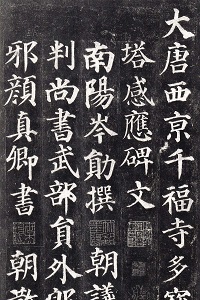 多寶塔碑
多寶塔碑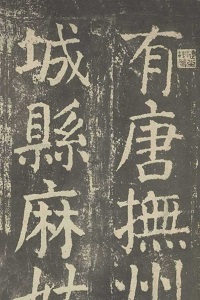 大字麻姑山仙壇記
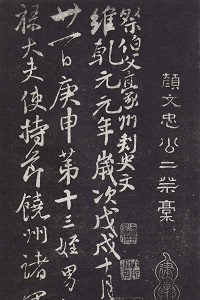 祭伯文稿
祭伯文稿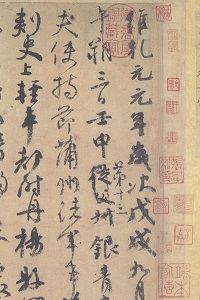 祭侄文稿
祭侄文稿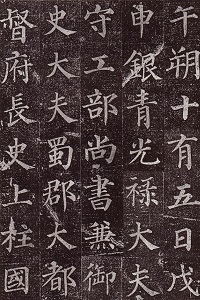 郭虛己墓志
郭虛己墓志Timeline
- Generally accepted birth year; born into the Yan clan of Langya.[1][2]
- Passed the metropolitan examination and began a career in censorial and local offices.[1]
- Wrote 《多寶塔碑》, providing evidence of his earlier regular script.[3][5]
- At the outbreak of the An Lushan Rebellion, defended Pingyuan as its governor, recruited troops and coordinated with districts in Hebei.[1]
- Yan Gaoqing, Yan Jiming and others were killed at Changshan, forming the historical background to the later sacrificial text.[2]
- Wrote 《祭侄文稿》 to mourn Yan Jiming.[2][7]
- Wrote 《爭座位稿》 to Guo Yingyi, criticising seating arrangements at a court gathering.[8]
- Held central and local offices and opposed Yuan Zai’s restrictions on direct memorials from officials.[1]
- Killed by Li Xilie. 《舊唐書》 places this in the first Xingyuan year, while the Palace Museums in Beijing and Taipei adopt 785; the date remains disputed.[1][2][3][6]
- The court awarded posthumous honours and a posthumous name and arranged his burial. Later generations continued to view his calligraphy alongside his image of loyal resistance.[1]
References
- 《舊唐書》, vol. 128: biography of Yan Zhenqing
- National Palace Museum, Taipei: 《祭姪文稿》
- The Palace Museum, Beijing: biographical entry for Yan Zhenqing
- Su Shi: 《書吳道子畫後》
- Institute of Calligraphy, Peking University: the aesthetic value of 《祭侄文稿》 and its association with Yan’s character
- Institute of Calligraphy, Peking University: Xu Bangda’s research on Yan’s death date and attributed works
- National Palace Museum, Taipei: drafting and revisions in 《祭姪文稿》
- Lu Yu: 《僧懷素傳》
- National Palace Museum, Taipei: description of 《爭座帖》