Work titles are retained in Chinese; references link to the original sources.
Wen Zhengming(文徵明)
Ming · 1470–1559
Originally named Bi, he adopted his courtesy name Zhengming as his name and changed the courtesy name to Zhengzhong; his sobriquet was Hengshan. After repeated examination failures and brief Hanlin service, he returned to Suzhou and became central to the Wu artistic community.
Biography
Wen was originally named Bi, used Zhengming as his name and later took the courtesy name Zhengzhong. He came from Changzhou; his father Wen Lin governed Wenzhou. 《明史》 records his refusal at sixteen of condolence money raised after his father’s death, and describes an initially unexceptional youth followed by gradual artistic distinction. The image of a naturally omnitalented Wu prodigy obscures long study.[1]
His teachers had distinct roles: Wu Kuan taught prose, Li Yingzhen calligraphy and Shen Zhou painting; all knew the Wen family. Zhu Yunming, Tang Yin and Xu Zhenqing were contemporary Wu friends. 《明史》 also records later associates such as Wang Chong, Lu Shidao and Chen Daofu, showing a reputation formed through decades of exchange, teaching and circulating works.[1][2]
The Palace Museum’s chronology records ten failed provincial examinations between 1495 and 1522. Recommended to the capital in his fifties, Wen briefly became a Hanlin attendant before repeatedly requesting retirement. Returning to Suzhou, he continued creating, teaching and meeting friends and collectors. His short official career must not make the Hanlin post his lifelong principal occupation.[1][2]
《明史》 calls him agreeable yet principled, recounting tactful refusal of money from governor Yu Jian and an invitation from the Prince of Ning, Zhu Chenhao. These stories shaped his reputation for literati integrity. Meanwhile commissions and the art market spread Wu works. The history explicitly reports pupil-made forgeries that Wen could not prevent. Surviving signed works require independent authentication.[1][6]
He practised poetry, prose, small regular and running scripts, landscapes, orchids and bamboo. Alongside Li Yingzhen’s teaching, he studied Jin–Tang works and Zhao Mengfu, repeatedly transcribing classical prose in old age. The 1551 《歸去來兮辭》 leaf is signed at eighty-two and shows sustained precision in small characters. His ninety-year lifespan produced a long range of works; early and late styles cannot be treated alike.[2][3]
His sons Wen Peng and Wen Jia also practised writing and painting; Wen Peng had particular influence on literati seal carving. The Wu painting tradition passed from Shen Zhou to Wen Zhengming and onward through relatives and pupils including Wen Boren, Qian Gu and Lu Zhi. Family transmission, pupil substitution and later imitation must be distinguished: signatures and seals alone do not settle authorship.[1][4][5][6]
Works and writings
- 《歸去來兮辭》 leaf: Palace Museum; signed in the ninth month of 1551 at age eighty-two. This transcription of Tao Yuanming’s prose is securely dated evidence for late small regular script.[3]
- Scrolls of 《滕王閣序》 and 《赤壁賦》: frequently transcribed classics. Each version’s script, inscription and authenticity require comparison; a shared title does not identify one scroll.[2][6]
- Landscapes, orchids, bamboo and combined poetry–calligraphy–painting scrolls: writing often accompanies original poems and colophons. His art should not be reduced to isolated signature characters.[2][4]
Relationships
- Wen Lin: his father and governor of Wenzhou. 《明史》 records Wen’s refusal of condolence money after his death.[1]
- Wu Kuan, Li Yingzhen and Shen Zhou: documented teachers of prose, calligraphy and painting respectively.[1][2]
- Zhu Yunming, Tang Yin and Xu Zhenqing: contemporary Wu friends who exchanged literary and artistic work. Group names do not establish formal teaching lineages.[1]
- Wen Peng and Wen Jia: his sons, both artists. Wen Peng also exerted substantial influence in seal carving.[1][5]
- Wang Chong, Lu Shidao, Chen Daofu, Qian Gu and others: younger associates and pupils who helped spread Wu artistic practice.[1][4][5]
Assessment
- 《明史》 presents agreeable yet principled conduct through refusals of money and princely patronage, alongside wide circulation of poetry and art. Ethics and artistic fame both inform its judgment.[1]
- The Palace Museum groups him with Zhu Yunming and Wang Chong as the Three Wu Calligraphers, and with Shen Zhou, Tang Yin and Qiu Ying as the Four Ming Painters. These groupings concern different arts and comparisons.[2]
- 《明史》 describes decades of Wu literary activity after Wen, Cai Yu and others, listing artists who associated with him. This reveals community influence more concretely than the single label of leader.[1]
- The Palace Museum treats Shen Zhou and Wen as successive figures in Wu School painting and notes the many Wen relatives and pupils. Teaching and circulation matter alongside personal technique.[4]
- 《明史》 warns that his fame encouraged many pupil-made forgeries; museum research also examines substitute writing. Authentication must precede reliable conclusions about his brushwork.[1][6]
Related works(1)
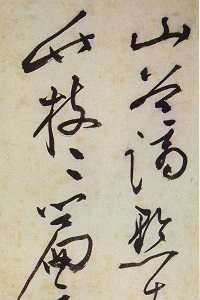 草書詩卷
草書詩卷Timeline
- Born into the Wen family of Changzhou.[1][2]
- Studied prose, calligraphy and painting with Wu Kuan, Li Yingzhen and Shen Zhou respectively.[1]
- Failed ten provincial examinations.[2]
- Recommended as a Hanlin attendant, then retired to Suzhou after several years.[1][2]
- Wrote the 《歸去來兮辭》 leaf, signed at eighty-two.[3]
- Died at ninety.[1][2]