Work titles are retained in Chinese; references link to the original sources.
Liu Gongquan(柳公權)
Tang · 778–865
Courtesy name Chengxuan; a native of Huayuan, Jingzhao. Serving successive emperors in the middle and late Tang, he developed a style from Wang Xizhi and Tang monumental traditions, celebrated for clarity, compact structure and strength.
Biography
Liu Gongquan, courtesy name Chengxuan, was born in Huayuan, Jingzhao, and was Liu Gongchuo’s younger brother. 《舊唐書》 appends his biography to his brother’s without reducing him to a dependent figure. After passing the metropolitan examination, he entered official service and gained court notice through writing, serving Muzong, Jingzong, Wenzong and others as attendant calligrapher, scholar and official. He died at eighty-eight; his long career across reigns is essential to understanding changes in his commissions.[1][2]
《舊唐書》 records Muzong’s praise and inquiry about brush technique. Liu used his answer to urge an upright mind; the emperor recognised a remonstrance through calligraphic language. The later maxim that an upright mind makes an upright brush is often used in teaching. In its original exchange, it concerned political ethics rather than an immediately practical stroke exercise.[1][2]
Liu continued to advise Wenzong as a court official. 《舊唐書》 records his warning about public criticism after two women entered the palace following Guo Min’s appointment; the emperor returned them. Together with the brush remonstrance, this episode shows engagement with court politics and reputation, beyond favour earned through writing.[1]
The histories say Liu began with Wang Xizhi, examined contemporary methods and formed a manner combining vigour with grace. High officials sought his calligraphy for monuments, reportedly regarding failure to secure it as unfilial, while foreign envoys brought goods to purchase it. These reports reveal the social value of memorials, letters and famous handwriting. They do not authenticate every later copy or carving attributed to Liu.[1]
Liu wrote more than regular script. 《舊唐書》 says Xuanzong ordered three sheets in regular, running and cursive scripts, then allowed him to choose a script for his acknowledgement. This establishes a broader range than 《玄秘塔碑》 alone. The history also records extensive knowledge and recitation of 《左傳》, 《國語》, 《尚書》, 《詩經》 and 《莊子》. Scholarship, imperial assignments and monumental inscriptions were connected cultural activities.[1]
《玄秘塔碑》, his best-known monument, was erected in 841 for the monk Duanfu. Text, writing, carving and successive rubbings together constitute the work. The Palace Museum’s Song rubbing is described through decisive, axe-like strokes, slender vigour and structures compact within but extending outward. 《神策軍碑》 and the stone 《金剛經》 allow comparison across subjects and periods; their stones and surviving impressions have different histories.[3][5]
In old age Liu held offices including Chancellor of the Directorate of Education, Minister of Works and senior tutor to the Crown Prince. The histories describe devotion to brushes, inkstones and art, poor management of family property and writing fees stolen by servants. He died in 865 and was posthumously named Grand Tutor to the Crown Prince. The later comparison of Yan’s sinews with Liu’s bones illuminates two manners, but cannot replace study of individual Liu monuments.[1][3]
Works and writings
- 《玄秘塔碑》: erected for Duanfu in 841, composed by Pei Xiu and written by Liu. The Palace Museum holds a Song rubbing. Date, text, function and impression quality should accompany the title.[3][4]
- 《神策軍碑》: a court commemorative monument of the middle or late Tang, often compared with 《玄秘塔碑》 for mature regular script. Surviving knowledge is chiefly through rubbings; stone and impression histories need checking.[5]
- Stone 《金剛經》: the histories describe Liu’s writing at Chang’an’s Ximing Monastery as combining Zhong Yao, Wang Xizhi, Ouyang Xun, Yu Shinan, Chu Suiliang and Lu Jianzhi. This records contemporary understanding of his synthesis, rather than assigning every stroke to a particular teacher.[1]
- Three imperial-audience sheets in regular, running and cursive: the history preserves their texts and the gifts awarded. Without evidence that the original sheets survive, this documentary account must not be listed as an extant museum autograph.[1]
- 《回元觀鍾樓銘》 and 《圭峰禪師碑》: appear in later catalogues of Liu monuments. Attribution, stones and rubbings should be checked work by work.[5]
Relationships
- Liu Gongchuo: his elder brother and an important Tang official; 《舊唐書》 places Liu Gongquan’s account after his biography.[1]
- Muzong: admired Liu’s writing and asked about technique, prompting the remonstrance on an upright mind.[1][2]
- Wenzong: composed linked verses with Liu and commissioned palace-wall writing. Liu also advised on appointments and court criticism.[1]
- Xuanzong: ordered Liu to write regular, running and cursive sheets before him.[1]
- Wang Xizhi: an early model, separated from Liu by centuries. This was study of tradition rather than direct instruction.[1]
- Yan Zhenqing: later paired with Liu as two characteristic Tang regular-script masters. The pairing does not establish a formal apprenticeship.[1][3]
Assessment
- 《舊唐書》 describes study of Wang and more recent methods leading to a style of vigour and grace. Strength and pleasing form coexist in this assessment; mere angular hardness is inadequate.[1]
- Wenzong praised Liu’s large palace-wall writing as beyond even a revived Zhong Yao or Wang Xizhi. This was enthusiastic imperial praise of a specific performance in a court setting.[1]
- Zhu Changwen’s 《續書斷》 places Liu in the excellent category with Ouyang Xun, Chu Suiliang and Huaisu. The Song ranking shows that the later Yan–Liu pairing did not imply two indistinguishable peaks.[6]
- The Palace Museum’s analysis of the Song rubbing of 《玄秘塔碑》 specifies slender vigorous strokes, inward concentration with outward extension, and decisive pointed endings. These details are more useful for visual study than the shorthand of Liu’s bones.[3]
- The maxim in 《舊唐書》 that an upright mind makes an upright brush was initially political advice to Muzong. Its later use to discuss moral character and artistic quality belongs to the history of reception.[1][2]
Related works(2)
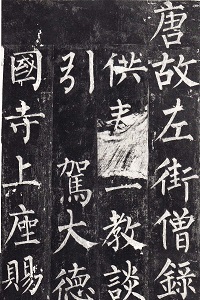 玄秘塔碑
玄秘塔碑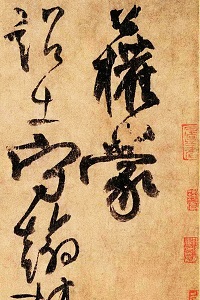 蒙詔帖
蒙詔帖Timeline
- Commonly accepted birth year; born in Huayuan, Jingzhao.[1][2]
- Passed the metropolitan examination and began official service. Undocumented monumental works must not be assigned to the examination year.[1][2]
- Gained recognition for writing and remonstrated through his answer concerning an upright mind and brush.[1]
- Served as Hanlin scholar, participating in linked verse, large palace-wall writing and court deliberations.[1]
- Wrote 《玄秘塔碑》, an important example of late regular script.[3]
- Wrote three sheets in regular, running and cursive scripts at an imperial audience and received gifts.[1]
- Died and was posthumously appointed Grand Tutor to the Crown Prince.[1]