Work titles are retained in Chinese; references link to the original sources.
Huaisu(懷素)
Tang · Life dates disputed; one account gives 737–799
A Buddhist monk and cursive calligrapher from Lingling. His family name was Qian and his courtesy name was Cangzhen. Famous for wild cursive script, he also left quieter small cursive works and letters.
Biography
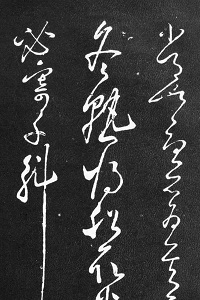
Huaisu was a Tang Buddhist monk whose family name was Qian and courtesy name Cangzhen. Drawing on works and historical records, the National Palace Museum describes his birth in Lingling, Hunan, later residence in Changsha and entry into monastic life as a youth. Shanghai Museum gives 737–799, whereas the Taipei museum describes activity approximately from the 730s to the 770s. Surviving evidence does not make either set of life dates indisputable. His reputation rests chiefly on cursive writing, but the legend of a drunken wild-cursive master obscures his studies and the variety of his works.[2][3][11]
Lu Yu’s 《僧懷素傳》 is an important early account. It describes his uninhibited temperament and writing after drinking on monastery walls, other walls, clothing and vessels. Unable to afford paper, he reportedly cultivated banana leaves for practice and repeatedly wrote on lacquered plates and boards. These stories occur in early literature and reveal how his diligence was understood; figures such as more than ten thousand plants remain biographical narration rather than evidence for a precise plantation size.[1]
Lu Yu says Huaisu’s paternal great-uncle, the monk Huirong, studied Ouyang Xun’s writing. Sharing the surname Qian, they were locally called the elder and younger Master Qian. Huaisu thus encountered a calligraphic tradition before leaving home. Wei Zhi predicted fame for his brushwork after seeing his letters. Huaisu later sought instruction in cursive technique from Wu Tong of Qiantang, whom Lu Yu identifies as his maternal cousin. This account is more specific than the general assertion that he studied directly under Zhang Xu.[1]
Wu Tong told Huaisu how Zhang Xu perceived cursive movement in wind-tossed tumbleweed and airborne sand. On parting, he described the handling of vertical strokes as the leg of an ancient hairpin. Zhang Xu’s experience therefore reached Huaisu through Wu Tong. This is indirect transmission; their familiar pairing as the mad Zhang and drunken Su does not prove direct teaching. Huaisu subsequently left Wu Tong and continued to visit masters and extend his friendships.[1]
His exchange with Yan Zhenqing is particularly well documented. Lu Yu reports that Yan asked whether Huaisu had discovered anything beyond the ancient-hairpin method taught to him. Huaisu answered that changing summer clouds, which had no fixed form, suggested the natural transformations of cursive writing. The account joins received teaching with personal discovery and records a discussion of brushwork. It establishes an artistic exchange, rather than a fixed master–pupil relationship.[1]
According to the National Palace Museum, Huaisu travelled north to Chang’an and Luoyang around 772. Leaving Lingling and Changsha, the monk entered scholarly circles in the two capitals, and his local reputation became a wider subject of poems and prefaces. He used these tributes to present his life and artistic standing. Poetic images of drunkenness, madness and divine assistance illuminate contemporary responses, but cannot be read line by line as a travel diary.[2][6][8]
《自敘帖》 bears a concluding date of 777. It is more than a conventional autobiography: an account of study and travel is followed by poems, prefaces and comments by friends, placing his writing within a network of contemporary praise. The Taipei scroll uses fine, vigorous strokes for large characters, with sustained movement and alternating continuity and breaks. Scholars disagree about the surviving scroll’s date and authorship. The textual inscription dated 777 must be distinguished from proof that the physical scroll is an autograph from that year.[2]
The surviving works show more than one cursive manner. Shanghai Museum’s 《苦筍帖》 is a short letter to a friend, unlike the long, publicly appreciated 《自敘帖》. The museum describes rounded movement and an archaic, understated feeling, and calls it the only undisputed surviving Huaisu autograph. Colophons on Taipei’s 《小草千字文》 repeatedly describe late small cursive writing. Colophons and dates document transmission, but authentication also requires examination of the support, ink, brushwork and ownership history.[3][4]
After his death, Huaisu was continually studied, copied and reassessed. 《宣和書譜》 pairs him with Zhang Xu and records many works attributed to him in the Song imperial collection, reflecting an attribution range different from today’s. Ouyang Xiu, Dong Qichang and the Qing critic Wang Wenzhi shift attention from reputation and natural expression in model books to understated small cursive writing. His full artistic range includes the speed of wild cursive, letters, small cursive works and the history of their colophons.[4][5][9][10]
Works and writings
- 《自敘帖》: a paper handscroll dated 777, held by the National Palace Museum, Taipei, 28.3 × 755 cm. Its text draws on poems and prefaces by several scholars. Continuous cursive movement and whole-scroll rhythm are celebrated, but the surviving version’s authenticity and date remain disputed.[2]
- 《苦筍帖》: a silk letter in Shanghai Museum; the written section measures 25.1 × 12 cm. The museum regards it as the only undisputed surviving Huaisu autograph. Rounded strokes and understated archaic expression show his quieter cursive manner.[3]
- 《小草千字文》: National Palace Museum, Taipei. Later colophons preserve collecting, appreciation and dating opinions, citing an inscription dated the seventeenth day of the sixth month of 799 at Lingling. That date should be reported accurately, without implying unanimous authentication of the surviving scroll.[4]
- 《論書帖》 and 《食魚帖》: often catalogued among works or transmitted versions attributed to Huaisu. Dong Qichang’s 《畫禪室隨筆》 includes 《食魚帖》 among examples of understated antiquity. Transmission, versions and authenticity require assessment of each work.[10][11]
Relationships
- Huirong: described by Lu Yu as Huaisu’s paternal great-uncle. He studied Ouyang Xun and was locally called the elder Master Qian; Huaisu was the younger Master Qian.[1]
- Wu Tong: a cursive teacher Huaisu actually visited and studied with. Lu Yu identifies them as maternal cousins. Wu’s transmission of Zhang Xu’s methods forms an indirect chain of instruction.[1]
- Zhang Xu: an earlier cursive master whose experience reached Huaisu through Wu Tong. Their pairing as the mad Zhang and drunken Su does not prove direct instruction.[1][5]
- Yan Zhenqing: discussed ancient-hairpin strokes, rain marks on a leaking wall and observations of summer clouds with Huaisu. Their exchange is documented in the literature.[1][2]
- Wei Zhi: recognised Huaisu’s letters early and predicted that his brushwork would become widely known.[1]
- Lu Yu: wrote Huaisu’s biography, preserving important accounts of practice, teachers and discussion with Yan. He was the biographer, and should not be misidentified as his calligraphy teacher.[1]
Assessment
- 《草書歌行》, attributed to Li Bai, calls Huaisu a young monk and describes drunken strokes like torrential rain and flying snow. It appears under Li Bai’s name in 《全唐詩》, but authorship is disputed. It cannot be used without qualification as testimony that Li Bai personally witnessed Huaisu.[6]
- Lu Yu’s 《僧懷素傳》 goes beyond madness. Alongside uninhibited writing after drinking, it details instruction from Wu Tong and Huaisu’s explanation of summer clouds to Yan Zhenqing. Diligent study and personal insight into natural change both inform his art.[1]
- Han Wo’s 《草書屏風》 imagines Huaisu’s brush from old ink on a screen, invoking strange rocks in rushing water, cold vines on ancient pines and characters about to become dragons. A widely repeated transcription replaces the word for traces with an erroneous word for crouching; the standard text refers clearly to Huaisu’s traces.[7]
- Guanxiu’s 《懷素上人草書歌》 uses Zhang Xu as a point of comparison and likens Huaisu’s wild cursive to tigers, lightning and battle. The poet ends by admitting that he never saw Huaisu himself, only his writing. The apparent eyewitness scenes therefore include literary imagination.[8]
- 《宣和書譜》, vol. 19, compares Huaisu with Zhang Xu and values spontaneous, rounded, soaring movement. Its numerous imperial-collection entries attest to his place in Song court connoisseurship.[5]
- Ouyang Xiu’s 《集古錄》 says Huaisu was famous in his day and especially treasured later, but also questions the practice of devoting an entire lifetime to calligraphy. Extracting only the praise loses his reservations.[9]
- Zhu Changwen’s 《續書斷》 places Huaisu in the excellent category with Ouyang Xun, Chu Suiliang and Liu Gongquan, while Yan Zhenqing and Zhang Xu occupy the divine category. This is a Song comparative framework, not evidence for authenticating every attributed work.[15]
- Jiang Zhiqi’s colophon on Taipei’s 《自敘帖》, dated 1083, declares that Huaisu profoundly understood cursive principles. Su Zhe, in another colophon, calls the scroll complete and extraordinary while admitting that he cannot fully discern its subtleties. These physical colophons are more specific evidence than general claims of Song admiration.[12]
- Dong You’s 《廣川書跋》 discusses 《懷素七帖》, treating Yan Zhenqing and Huaisu as regular- and cursive-script successors after Zhang Xu. He distinguishes Zhang’s abandon from Huaisu’s respect for rules. This passage is sometimes assigned online to Su Shi, but the original book identifies Dong You.[14]
- Huang Tingjian considers Huaisu’s late cursive comparable to Zhang Xu’s while distinguishing Zhang’s fuller lines from Huaisu’s slender vigour. Slenderness is an aesthetic comparison, and does not mean that every Huaisu work is weak or thin.[16]
- Zhao Mengfu’s colophon on the attributed 《論書帖》 says Huaisu’s wildly varied writing nevertheless preserves Wei–Jin principles; the Taipei museum records the statement. Online versions sometimes attribute it to Shen You. Authorship should be checked against the scroll itself.[13]
- In 《畫禪室隨筆》, Dong Qichang values the understated archaic character of works he knew under Huaisu’s name, including 《苦筍帖》 and 《食魚帖》. This differs from equating Huaisu solely with unrestrained wild cursive and explains interest in his letters and small cursive.[10]
- In a colophon on 《小草千字文》, Wang Wenzhi says Zhang Xu and Huaisu developed wild cursive from Wang Xizhi, but finds Huaisu’s small cursive especially valuable for a quiet plainness that dispels restlessness. This is an assessment of a particular transmitted work, not a uniform verdict on all his writing.[4]
- Taipei’s formal analysis of 《自敘帖》 stresses fine strokes forming large characters, rounded lines, and a rhythm of continuity and interruption between characters and columns. Shanghai Museum describes 《苦筍帖》 as rounded, lively, natural and archaically understated. Their separate analyses reveal a greater range than the single label of wild abandon.[2][3]
Related works(17)
 冬熟帖
冬熟帖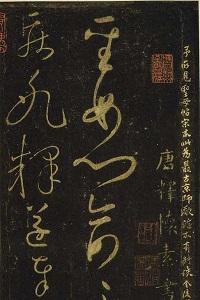 聖母帖
聖母帖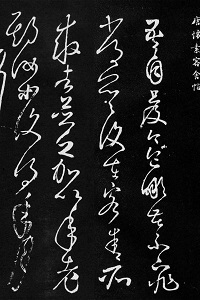 客舍帖
客舍帖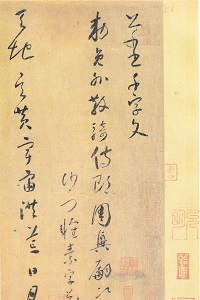 小草千字文
小草千字文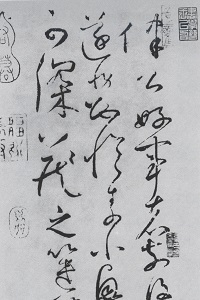 律公帖
律公帖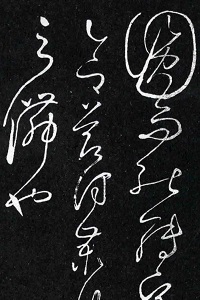 桑林帖
桑林帖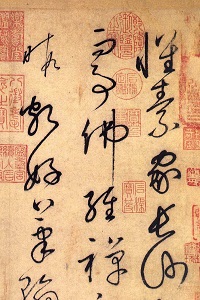 自敘帖
自敘帖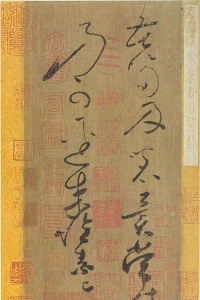 苦筍帖
苦筍帖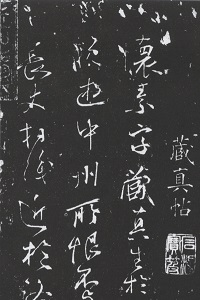 藏真帖
藏真帖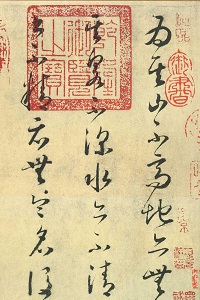 論書帖
論書帖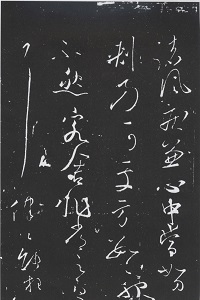 貧道帖
貧道帖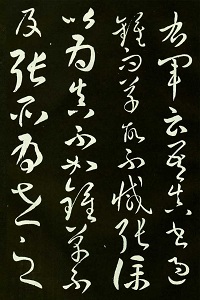 過鍾帖
過鍾帖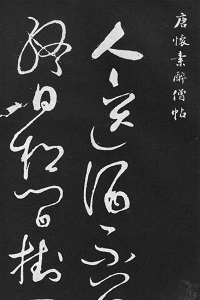 醉僧帖
醉僧帖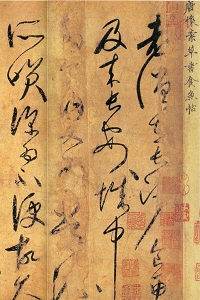 食魚帖
食魚帖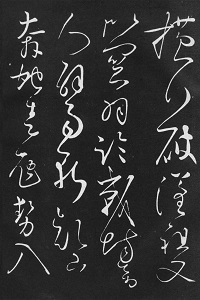 高坐帖
高坐帖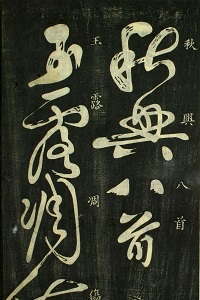 秋興八首
秋興八首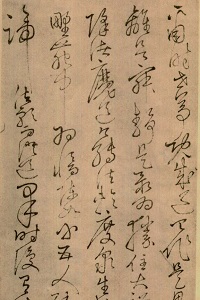 四十二章經
四十二章經Timeline
- Shanghai Museum adopts 737 as his birth year; the National Palace Museum does not give a definite year.[2][3]
- Entered monastic life in Lingling and became devoted to cursive writing. Lu Yu records practice on banana leaves, lacquered plates and boards.[1][2]
- Encountered tradition through his great-uncle Huirong, gained recognition from Wei Zhi and later formally sought instruction from Wu Tong.[1]
- Discussed hairpin strokes, leaking-wall marks and summer clouds with Yan Zhenqing. The exact year is unknown.[1]
- According to the Taipei museum, travelled to Chang’an and Luoyang and entered wider scholarly circles.[2]
- The text of 《自敘帖》 bears this date; whether the surviving scroll is an autograph from that year is disputed.[2]
- Colophons on 《小草千字文》 cite the seventeenth day of the sixth month of 799 at Lingling. Inscription dating must be distinguished from authentication.[4]
- Shanghai Museum adopts 799 as his death year; other collection descriptions are less definite about his life dates.[2][3]
- 《宣和書譜》, vol. 19, records more than a hundred cursive works attributed to Huaisu, reflecting Song court collection and attribution practices.[5]
References
- Lu Yu: 《僧懷素傳》, in 《全唐文》, vol. 433
- National Palace Museum, Taipei: 《自敘帖》
- Shanghai Museum: 《草書苦筍帖卷》
- National Palace Museum, Taipei: colophons on 《小草千字文》
- 《宣和書譜》, vol. 19: Huaisu
- 《草書歌行》, attributed to Li Bai in 《全唐詩》
- Han Wo: 《草書屏風》
- 《書苑菁華》, vol. 17: Guanxiu’s 《懷素上人草書歌》
- Ouyang Xiu: 《集古錄》, vol. 8
- Dong Qichang: 《畫禪室隨筆》, vol. 1
- Wikipedia: Huaisu, biographical and bibliographic leads
- National Palace Museum, Taipei: collection record and colophons for 《自敘帖》
- National Palace Museum, Taipei: Zhao Mengfu’s colophon on the attributed 《論書帖》
- Dong You: 《廣川書跋》, vol. 8, 《懷素七帖》
- Zhu Changwen: 《續書斷》
- Tsinghua alumni research: Huang Tingjian on Zhang Xu and Huaisu