Work titles are retained in Chinese; references link to the original sources.
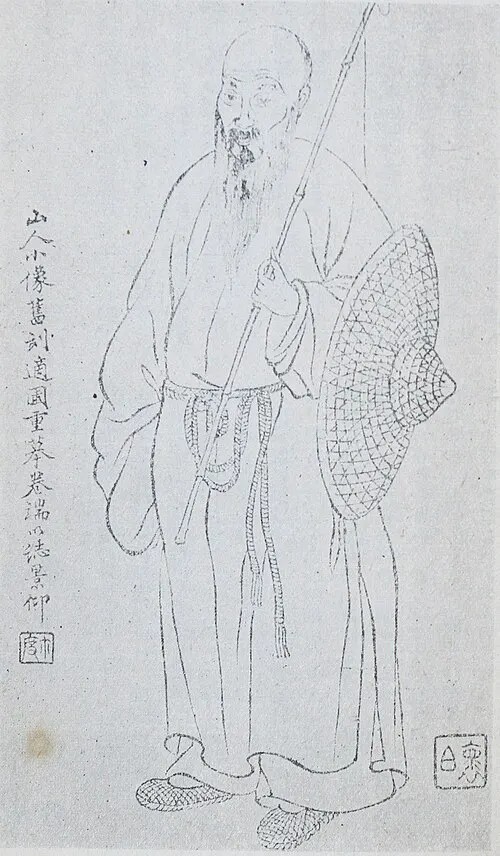
Deng Shiru(鄧石如)
Qing · 1743–1805
Originally named Yan, he adopted his courtesy name Shiru as his name and took the courtesy name Wanbo; his sobriquet was Wanbai Shanren. Sustained study of inscriptions shaped influential seal, clerical and seal-carving work.
Biography
Deng was born near Jixianguan in Huaining, Anhui. Originally Yan, he adopted his courtesy name Shiru to avoid the Jiaqing emperor’s name, and also used Wanbo and Wanbai Shanren. From a poor family, he favoured stone carving and imitation of Han seals. 《清史稿》 recounts meeting Liang Yan in Shouzhou, who introduced him to Mei Liu in Jiangning. Mei supplied living expenses, paper, ink and access to fine inscription collections for prolonged study.[1][2]
The biography describes eight years at Mei’s house: repeated study of 《石鼓文》, Qin inscriptions, Han monument headings and Li Yangbing, together with copies of 《說文解字》, followed by Han clerical models such as 《史晨碑》, 《華山碑》 and 《張遷碑》. It assigns about five years to seal and three to clerical writing. These biographical stages at least establish sustained learning, rather than sudden innate mastery.[1]
After leaving Mei, Deng supported himself through writing and carving while travelling in Jianghuai and Huangshan. In Shexian, Zhang Huiyan admired his seal writing; Zhang and Jin Bang visited him and introduced him to Cao Wenzhi. In Beijing, Liu Yong and Lu Xixiong praised his seal and clerical scripts, while Weng Fanggang disagreed. 《清史稿》 records both admiration and controversy, revealing competition over ancient methods and artistic orthodoxy.[1]
Deng spent about three years in Bi Yuan’s household. The biography contrasts his plain dress and walking with richly dressed guests; Bi supplied land, a home and parting gifts. Deng’s reputation came from works, inscription knowledge and patronage networks rather than examinations or office. He married at forty-six, continued travelling in Jianghuai and died in 1805.[1][2]
Especially accomplished in seal and clerical scripts, Deng also wrote regular script. His seals brought small-seal movement into the seal surface beyond exclusive imitation of Han white-character designs. Shanghai’s 1788 examples combine rounded lines and pushing cuts. Beijing’s regular-script 《滄海日長》 couplet corrects an exclusively seal–clerical image. Paper writing, original seal stones and impressions in albums need separate analysis.[2][3][4]
Bao Shichen, a younger disciple, wrote 《完白山人傳》 and vigorously promoted Deng. Bao’s own artistic and political views give his valuable account a clear position. His divine-category ranking should not become a claim of universal Qing agreement. Deng inspired later inscription-based writing, but each follower’s models and actual personal contact require independent identification.[1][2][7]
Works and writings
- 《滄海日長》 couplet: Palace Museum paper work in regular script, dated from its inscription to 1796. It demonstrates a range beyond seal and clerical scripts.[3]
- 《篆書謙卦軸》: Shanghai Museum paper hanging scroll, useful for studying extended seal-script composition.[5]
- Seals dated 1788: Shanghai identifies small-seal structures within white-character designs, combining pushing cuts with rounded writing movement.[4]
- Copies of 《石鼓文》, 《嶧山碑》, 《史晨碑》 and 《張遷碑》: recorded as repeated practice and models. The ancient monuments themselves must not be listed as Deng’s creations.[1]
- 《完白山人篆刻偶存》: a compilation involving stones, impressions and later albums, rather than one seal carved in a single year.[2]
Relationships
- Liang Yan: recognised Deng’s seal writing in Shouzhou and introduced him to Mei Liu.[1]
- Mei Liu: supplied inscriptions, living expenses, paper and ink for long study.[1][2]
- Zhang Huiyan, Jin Bang and Cao Wenzhi: admiration, visits and recommendations connected Deng to Beijing scholarly circles.[1]
- Liu Yong, Lu Xixiong and Weng Fanggang: the first two praised him, while Weng criticised him, disproving universal contemporary approval.[1]
- Bi Yuan: hosted Deng for about three years.[1][2]
- Bao Shichen: younger disciple and biographer who systematically promoted Deng’s writing and inscription-based criticism.[2][7]
Assessment
- 《清史稿》 connects his seal method to Li Si, Li Yangbing and the Zhou scribe tradition, describing added clerical handling, vigorous bends and slightly squared structures. It links sources with visible form.[1]
- Zhang Huiyan compared his writing to an encounter with Li Si’s autograph, while Liu Yong and Lu Xixiong praised an achievement rare for more than a millennium. These biographical statements reflect contemporary enthusiasm for renewed seal writing.[1]
- 《清史稿》 directly records Weng Fanggang’s criticism associated with Deng’s refusal to enter his circle. Selected praise alone cannot establish universal Qianlong–Jiaqing admiration.[1]
- Li Zhaoluo praised pervasive natural energy and departure from fashion; the Palace Museum cites this as later admiration for antiquity and independence. A general judgment still needs comparison with individual works.[2]
- Bao’s 《完白山人傳》 details brush handling and study, and ranks Deng as divine. A disciple’s valuable observations require comparison with biographies, objects and contemporary criticism.[6][7]
- Shanghai’s analysis of rounded small-seal lines and pushing cuts in the 1788 seals explains how writing entered carving. Calligraphic success cannot simply substitute for analysis of a seal surface.[4]
Related works(1)
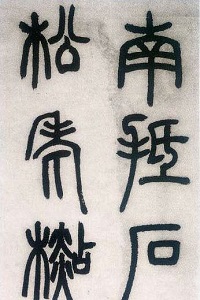 白氏草堂記
白氏草堂記Timeline
- Born in Huaining, Anhui.[1][2]
- Through Liang Yan, entered Mei Liu’s household for about eight years of inscription study.[1]
- Repeatedly copied seal and clerical monuments and 《說文》, developing both scripts.[1]
- Through Zhang Huiyan and others, visited Beijing and met Liu Yong and Lu Xixiong; later stayed with Bi Yuan.[1]
- Shanghai seals show small-seal movement within white-character carving.[4]
- Wrote the regular-script 《滄海日長》 couplet now in the Palace Museum.[3]
- Died. Bao Shichen and others subsequently wrote biographies and spread his methods.[1][2]