Work titles are retained in Chinese; references link to the original sources.
Dong Qichang(董其昌)
Ming · 1555–1636
Courtesy name Xuanzai; sobriquets Sibai and Xiangguang Jushi; a native of Huating. He combined a long official career with artistic creation, collecting and criticism. His northern–southern schools theory influenced later painting.
Biography
Dong Qichang, courtesy name Xuanzai, came from Huating. He passed the metropolitan examination in 1589, became a Hanlin probationer and compiler, and later taught the emperor’s eldest son. One Palace Museum entry gives 1588, conflicting with 《明史》, the museum’s thematic account and the 1589 examination date; the latter is used here with the discrepancy noted. His intermittent career included academy posts, provincial education and ultimately the Nanjing Ministry of Rites.[1][2][3]
《明史》 recounts Dong escorting his deceased instructor Tian Yijun’s coffin home, and resisting private influence as Huguang education commissioner. Powerful families and students then attacked his office, after which he resigned. This is one historical account of his official reputation. Palace Museum family research and Shanghai’s chronology also record the 1616 popular attack on the Dong household. Causes and responsibilities differ across documents and cannot be reduced to one narrative.[1][6][7]
Under Guangzong and Xizong he returned to ritual, educational, historical and ministerial posts. Compiling 《神宗實錄》, he travelled south to gather memorials and accounts, 《明史》 reports assembling and classifying hundreds of volumes with comments. He participated in official history as well as collecting art. Documentary work and connoisseurship are distinct, though both involve comparison, judgment and organisation.[1]
Dong continually adjusted his models. The Palace Museum describes his reluctance to follow fashionable Zhao Mengfu and Wen Zhengming manners and his synthesis of Jin, Tang, Song and Yuan model books into open, graceful structures with archaic awkwardness. The often-noted lightness rests on specific spacing and relationships between upright and tilted characters, not merely weak strokes.[2][3]
Artistic exchange and collecting connected him throughout Jiangnan. The colophon on Shanghai’s 1603 《行草書羅漢贊等卷》 records three friends visiting in rain, tea, ink grinding and brush trials, with writing gradually becoming freer. Place, date, companions and process anchor style in an actual occasion. His northern–southern painting theory profoundly influenced Ming–Qing literati painting, but is not directly a division of calligraphy.[4][5]
His great reputation spread scrolls, letters and colophons, accompanied by imitations and misattributions. Shanghai’s exhibition spanning earliest paintings to final works stresses continued exploration across decades. Works of similar date, colophon subjects and documentary sources should be read together; one late sheet cannot represent an entire career.[3][5]
Works and writings
- 《行草書羅漢贊等卷》: Shanghai Museum; its colophon records a rainy day in Suzhou’s Yunyin Shanfang in 1603. Writing progresses from understatement toward freedom, with later cursive comparable to Huaisu’s movement.[4]
- 《畫禪室隨筆》: a collection of artistic views and colophons, essential for studying old models, collecting and northern–southern theory. It is not a single ink work.[2][5]
- Running-cursive scrolls, letters and painting inscriptions in Beijing and Shanghai: subjects, formats and dates vary; catalogues should support comparison of early, middle and late writing.[3][5]
- Documents gathered for 《神宗實錄》: memorials, historical accounts and classified comments belong to historical compilation, not a list of representative calligraphic works.[1]
Relationships
- Tian Yijun: his Hanlin instructor, whose coffin Dong escorted home for burial.[1]
- Guangzong, Zhu Changluo: taught by Dong as prince; recalled him to court after accession.[1]
- Wang Shimin: a younger follower influenced by Dong’s painting and theory.[5]
- Mi Fu, Yan Zhenqing, Yang Ningshi and the Two Wangs: earlier models whose contributions to structure, strokes and composition are analysed by the Palace Museum.[3]
- Dong’s sons and Huating residents: participants in the 1616 local conflict. Accounts of responsibility differ, so Dong himself, relatives and rumours must be distinguished.[6][7]
Assessment
- 《明史》 describes artistic fame as well as teaching, education and historical service. Its account differs from local narratives of the household attack; source perspectives must be made clear.[1][6]
- The Palace Museum explains Dong’s expansive ease through generous spacing and structures balancing unusual forms without grotesqueness and correctness without suppressing variety. This is more specific than a generic literati spirit.[3]
- The Palace Museum describes his assimilation of the Two Wangs, Yan, Yang and Mi until obvious traces of particular models disappear. Seeking freshness after mastery does not mean avoiding copying.[2][3]
- Shanghai treats northern–southern painting theory and its practice as a major turn in literati painting and exhibits changes over more than forty years. Painting history may inform, but should not mechanically govern, assessments of calligraphy.[5]
- The 1616 attack divided later judgments of his character. Research on his sons reveals family members, local power and residents as participants. Unsupported anecdotes cannot settle moral judgment, while artistic achievement cannot erase social history.[6][7]
Related works(5)
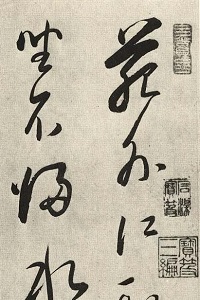 苑外江頭
苑外江頭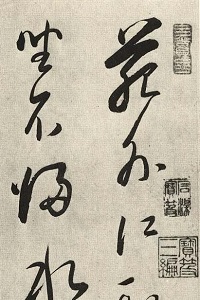 苑外江頭
苑外江頭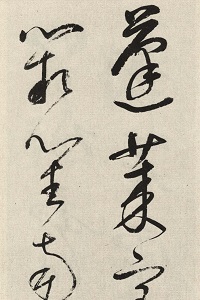 蓬萊宮闕
蓬萊宮闕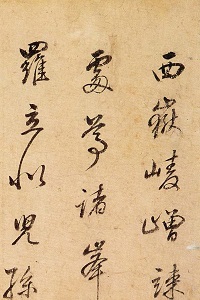 行書《望嶽》詩卷
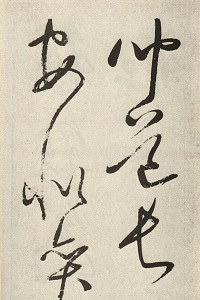 聞道長安
聞道長安Timeline
- Born in Huating.[2]
- Passed the examination in Wanli’s seventeenth year. One museum entry gives 1588, while history and thematic research give 1589.[1][2]
- Served as Hanlin compiler and imperial tutor, then Huguang education commissioner before resigning.[1]
- Wrote 《行草書羅漢贊等卷》 at Suzhou’s Yunyin Shanfang; its colophon records the day’s visitors.[4]
- Conflict between the Dong family and residents led to an attack on the household. Causes and responsibility remain differently reported.[6][7]
- Collected documents for 《神宗實錄》 and later became Nanjing Minister of Rites.[1][2]
- Died; posthumous name Wenmin.[1][2]